
D15 (Atlantic)
R318 (Pacific)
ATLANTIC 1944
ARCTIC 1944-45
Builder: Builder: Swan Hunter & Wigham Richardson shipbuilders Wallsend-on-Tyne
Displacement: 117,210 tons
Length (Overall): 528ft 6in
Beam: 68ft
Draught: 21 ft
Flight deck: 495ft x 60ft mild steel plate
Propulsion: 2 Doxford diesels driving 2 shafts
Speed: 17 knots
A/C Capacity: 21
Hangar: 231 ft × 61 ft x 17ft 6in
A/C lifts: 1, aft, 45ft long x 34ft wide
Arrestor wires: 8 with 2 barriers
Catapult: None
Armament: 1 twin 4in QF Mk XVI HA, 4 quadruple 2 pounder "pom-pom", 8 twin 20mm Oerlikon
Crew Complement: 554
Capt. H.T.T. Bayliss RN DSO Sep 43 - Jun 44
Cdr. J. D. L. Williams RN DSC Jun 44 - Mar 46
Capt. J. L. Armstrong RAN DSO Oct 45 - Mar 46
Cdr. J. D. L. Williams RN DSC Mar - Nov 46
Paid off to reserve
Cdr M. R. B. Deane Nov 1946
784B
April 1944
Fulmar II
811
Sept-Dec 44
Swordfish II/
Wildcat V
813
April-May 1945
Swordfish II/ Wildcat IV
825
Dec 43-Jan 45
Swordfish I/II
None
None

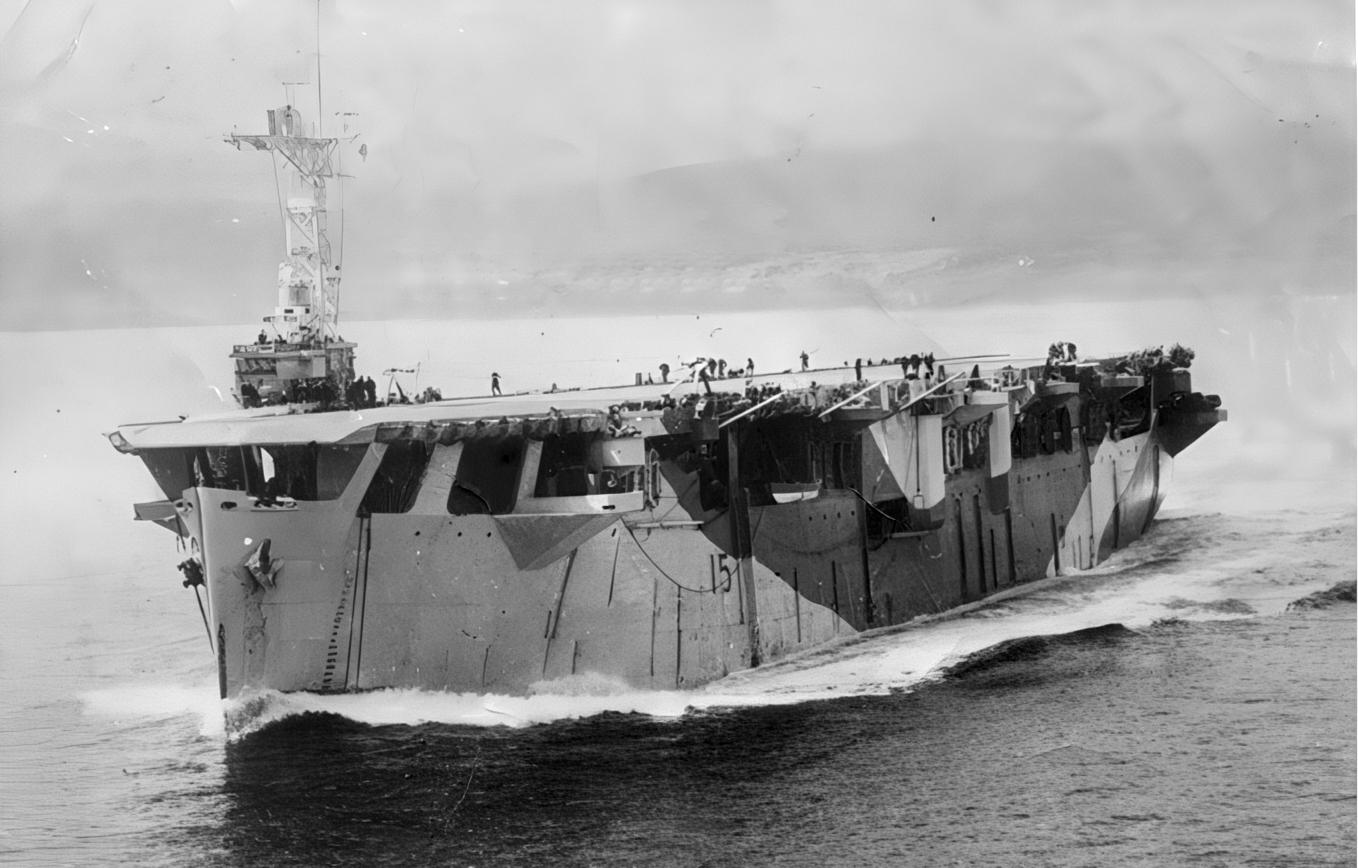
December 1st 1943, HMS VINDEX during her acceptance trials in the Firth of Forth.
Following the successful conversion and operation of the first, but short-lived, escort carrier HMS AUDACITY, the Admiralty urgently sought to convert more merchant vessels, but all available shipping was reserved for the Ministry of War Transport. However, several incomplete hulls became available from January 1942.
In January 1942, the hull of the refrigerated cargo carrier MV EMPIRE ACTIVITY was the first vessel requisitioned while building at the Caledon Shipbuilding & Engineering company in Dundee. This was to be a one-off design, and she entered service as HMS ACTIVITY In July 1942, the Admiralty requisitioned three more merchant gulls, while still on the stocks, for completion as NAIRANA Class escort carriers.
Two of the ships chosen were sisters, fast cargo-passenger ships being built for the Port Line Ltd, of London; the PORT PIRIE by John Brown & Company on the Clyde was to become HMS NAIRANA, and the PORT SYDNEY at Swan Hunter on the Tyne was to become HMS VINDEX. The third selection was the construction of a refrigerated cargo ship for the Shaw Savill Line at Harland and Wolff’s yard in Belfast. When completed, she became HMS CAMPANIA. All were named after WW1 seaplane carriers. The three carriers were to be built to the same design; the prototype was built by John Brown, who supplied the other two companies with copies of the plans, but in reality, they were all slightly different. NAIRANA and VINDEX were only slightly different from each other; CAMPANIA was sufficiently different that she could almost be considered a one-off build rather than part of the class. There was one other carrier converted in a British yard: HMS PRETORIA CASTLE, a former passenger liner requisitioned as an Armed Merchant Cruiser in 1939. Purchased the Admiralty in July 1942 and converted at Swan Hunter, she commissioned in July 1943 but was used only as a trials and training carrier.
On July 21st 1942, the keel of the MV PORT SYDNEY, a fast cargo-passenger ship ordered by the Port Line Ltd, of London, was laid down at the yard of the Swan Hunter on the Tyne. She was requisitioned by the Admiralty on October 20th of that year for completion as an Auxiliary Escort Aircraft Carrier; designated Job Number 4698, the name “VINDEX” was allocated.
Her hull was launched on May 4th 1943, and moved to the nearby fitting out wharf for completion. Essential personnel had begun arriving in July, including the ship’s executive Officer, Commander G. A. K. McCombe RNVR, and key engineering and supply staff. Her commanding Officer, Captain H. T. T. Bayliss RN, arrived on board in September, and the ship was ready for her builders’ trials by November of that year. Captain Bayliss was an experienced naval officer who had joined the RN in 1916, and on reaching the rank of Lieutenant in 1920, trained as a Naval Observer. He began his aviation career as a probationary observer on the Battleship HMS QUEEN ELIZABETH in 1923; prior to his appointment to VINDEX, he had been the commanding officer of the American-built Escort Carrier ARCHER.
Job Number 4698 was to be commissioned on November 15th. A large naval drift, the bulk of her crew, arrived at the shipyard at 06:00 that morning. Captain Bayliss, however, was unable to preside over the ceremony; he had contracted a bad case of the Flu and had been confined to his bed ashore the day before. Commander McCombe read the commissioning warrant naming her as “VINDX” . She was the second ship to bear the name; the first was a seaplane carrier during the First World War. After completing work to rectify defects identified during her trials, a successful full-power trial was conducted on December 2nd, and her build was officially completed the next day.
Captain Bayliss was fit enough to rejoin the ship on the 18th and addressed the ship’s company at a Clear Lower Deck that morning. A dedication service was held in the hangar on the 20th; the service was led by the Bishop of Newcastle. After the service, a party was held for the ship’s officers and senior dockyard employees; The Bishop christened the baby of one of the young officers using the ship’s bell as a font. Later that day, preparations began for her departure from her builder’s yard for the first time under her own steam.
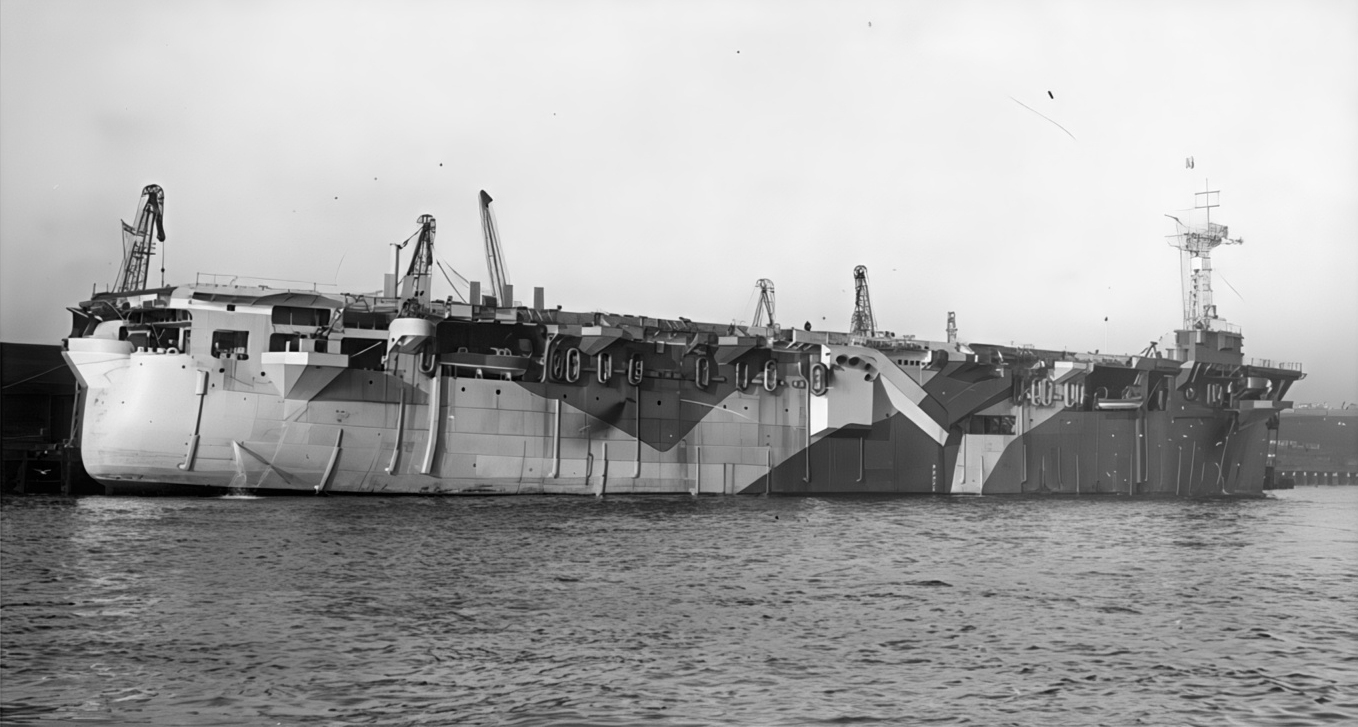
November 21st, HMS VINDEX secure alongside the Tyne commissioner’s Quay at North Shields.
With the aid of tugs, VINDEX departed late in the morning of November 21st and moved downstream to secure alongside the Tyne commissioner’s Quay at North Shields around noon. Here, she spent the next two days embarking 4-inch, 2-pounder, and 20-millimetre ammunition magazines, before embarking more stores and making final preparations for sailing to conduct her acceptance trials. At 16:15 on November 30th, the white ensign was hoisted for the first time, and VINDEX sailed into the North Sea and proceeded to Rosyth, anchoring in the harbour in the early hours of December 1st. She weighed at 08:15 and put to sea to commence her Admiralty acceptance trials, which were completed the following day. Captain Bayliss signed the official paperwork accepting the ship on behalf of the Admiralty. Included with this was a letter reiterating an objection he had raised earlier during the build, in which he stated that the mercantile anchors installed were not sufficient to handle the additional weight of the warship conversion. The Admiralty had decided to leave things as they were, however, and this would later prove to be an oversight that could have been avoided.
VINDEX sailed for Greenock on December 10th, arriving on the Clyde the next day to begin working up the ship and to receive her first aircraft with which she would conduct flight operations in preparation for active service with Western Approaches Command.
On the morning of the 13th, an advance party of sixty-one members of 825 squadron arrived on board. The ship conducted exercises and calibrations over the next three days before sailing to the flying training area off Rothsay to await her first aircraft on December 17th. This was a single Grumman Avenger Torpedo Bomber belonging to Mo. 778 Service Trials Unit, piloted by Lt. A. Whalley RN, which arrived overhead at 14:30. Over the next 2½ hours, he made repeated landings and take-offs to test the arrester gear and give the flight deck parties experience of flight deck operations. The ship anchored off Rothsay that night and prepared to receive her allocated squadron the next morning. At 11:00, off Cumbrae Light, the 6 Sea Hurricane IIc fighters belonging to 825 squadron landed on, followed shortly after by 12 Swordfish II torpedo Bombers; the squadron had flown out to join the ship from their base at RNAS Inskip in Lancashire. This composite squadron provided anti-submarine search and attack using the Swordfish biplane, with the added fighter-interception capability of the Sea Hurricane; the only major handicap of this combination was that the Sea Hurricane lacked folding wings, which limited the number that could be carried.
Only one aircraft experienced problems embarking; Swordfish LS375, piloted by Sub-Lt P. E. Cumberland RNVR, with his Observer Mid F. R. Jackson RNVR, made a heavy landing on the rounddown, short of the first arrestor wire. The impact collapsed the undercarriage, and the remaining aircraft in the landing circuit had to make several orbits of the ship while the aircraft was recovered.
The ship went to flying stations in the afternoon of the 19th to give some pilots Deck Landing Practice (DLP). Sub-Lt Cumberland, in particular, was singled out, as a relatively inexperienced pilot was ordered to perform a series of circuits and bumps, making an approach to land and then opening up the throttle to go around again once his wheels had touched. Midshipman Jackson insisted on accompanying him even though this was purely pilot training. Among the Sea Hurricane pilots participating, one, Lt. A. H. D. Gough RNVR, landed in NF7I9 with his arrester hook up and flew into the barrier. Also, airborne that afternoon was the Commander Flying, Lt. Cdr (P) P. D. Gick RN DSC, taking up a Swordfish accompanied by Lt. Cdr (O) F. Stovin-Bradford RN, DSC, the ship’s Air Staff Officer, intent on assessing the flight deck equipment for himself and to see the flight deck parties in action.
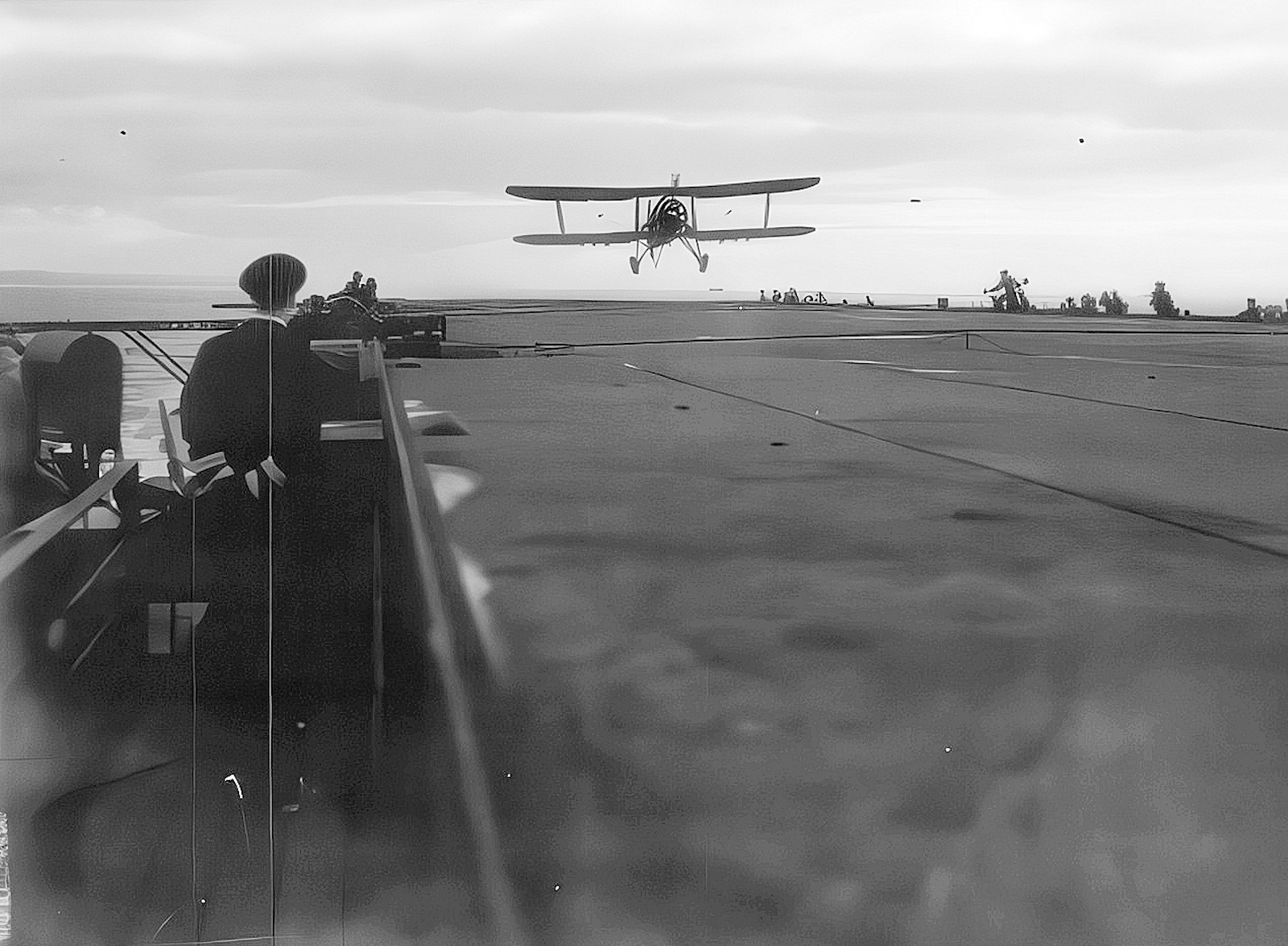
Flying training continued when the weather permitted, but the ship continued her workup exercises regardless; on Christmas Eve, the carrier exercised with HM Submarine SPIRIT, which conducted attack exercises in the Clyde area with VINDEX acting as the target vessel. Christmas Day was spent at anchor, but the two vessels conducted day-and-night exercises on the 26th. SPIRI repeated her role as the attacker before the focus shifted to VINDEX hunting her, launching Swordfish for Anti-submarine (A/S) exercises. 825 Squadron had two flying incidents on this date; Sea Hurricane NF7I9 piloted by Sub-Lt J. E. Moore RNZNVR, failed to catch a wire and floated into the barrier, damaging two Swordfish in the aircraft park; he was OK, but his aircraft was a write-off. During the night phase of the exercises, Swordfish LS379, piloted by Sub-Lt C. R. K. Webb RNZNVR, entered the barrier after the aircraft's landing lights failed over the rounddown. The crew were unhurt. The experience of night A/S operations was new to 825 squadron. There were two more Swordfish landing incidents on New Year’s Eve. HS287, piloted by Sub-Lt E. W. Powell-Chandler RNZNVR, suffered damage to the port lower wing and spinner, while HS158 became the second night landing barrier crash; Sub-Lt D. G. Trussell RNVR and his crew were OK.
The New Year brought more joint exercises with a submarine, this time HM/S VOX; the carrier served as the target vessel during both day and night attack simulations on January 6th, 1944. Sub-Lt. R. E. Huggins, RNVR, crashed Swordfish LS380 ('A’) into the barrier during a night landing on the 9th. On the 14th, a Swordfish was lost overboard while landing; this was NE866, crewed only by Sub-Lt. Powell-Chandler, who was safely rescued.
VINDEX was the target vessel for Night attack exercises with HM/S STRONGBOW in the Clyde area on the 16th, followed by more night exercises the next night, but this time employing aircraft. For her next round of day and night A/S exercise, VINDEX operated in the Irish Sea, rendezvousing with HM/S TANTALUS off the port of Larne, County Antrim, on January 19th and 20th, TANTALUS acting as the target. At 10:30 on the morning of the 20th, the ship was visited by the Flah Officer Carrier Training (FOCT) Vice-Admiral Lumley Lyster to assess the ship’s operational readiness; he was not impressed and left remarking that he wanted to see “not only an improvement, but a transformation”.
On completion of the day’s exercise, VINDEX sailed for Rothsay Bay, where she anchored in company with the US-built Carriers CHASER, HUNTER and PURSUER. In the early hours of the 22nd, VINDEX’s inadequate mercantile anchors dragged, and the ship drifted; her port quarter collided with PURSUER’s bow. The impact tore away the Deck Landing Control Officer’s platform, together with 50 feet of deck edge walkway, and the no. 6 Oerlikon gun platform was damaged. A small leak in the hull below the waterline was also discovered. Only superficial damage was done to PURSUER.
VINDEX moored to B.2 Berth on the Clyde on the 23rd and remained there until the afternoon of February 13th, when she entered drydock, with the aid of tugs, for examination and repair work to be carried out. She was undocked on the 23rd and moved to C.2 berth. She sailed to resume flying operations on the 26th. At 10:30, Swordfish ('W') LS393 ditched; its engine failed due to contaminated fuel. The crew, Sub-Lt. E. W. Powell-Chandler RNZNVR & Lt D. O. Reas RNVR picked up OK by ML547. At 11:50, a second Swordfish, NE870 ('B'), suffered the same issue and ditched. The crew was picked up by ML547, the pilot, Sub-Lt. D. G. Trussel was rescued, but his observer, Sub-Lt. H. Broadley was killed.
On March 2nd, VINDEX arrived in Lough Larne to prepare for trade protection operations. Western Approaches Command was to operate CVEs in pairs to hunt and destroy U-Boats in the North Atlantic, either in rotation as ‘duty carrier’ or one specialising in daylight operations, the other night flying. From March 1944, the American-built CVE STRIKER was paired with VINDEX, which was equipped for night operations. STRIKER arrived at Larne later that evening. Operational requirements, however, meant that the two carriers were not to operate together straightaway. STRIKER, as an experienced convoy escort carrier, was detached to cover the joint outbound Gibraltar/West Africa convoy OS70/KMS44, providing cover from March 3rd to March 15th, when the two convoys split.
VINDEX (Captain Baylisss, Senior Officer) left B.3 berth on the Clyde on the morning of March 8th in company with the vessels of the 6th (Canadian) Escort Group (6EG), which comprised the Canadian Destroyer QU'APPELLE, Frigates WASKESIU & OUTREMONT, with Corvettes PRESCOTT & EDMUNDSTON, for her first operational sortie. They were to be joined on station by the 2nd Escort Group (2EG), under the command of Captain F.J. Walker, CB, DSO and 2 Bars, RN, with Sloops STARLING (S.O), WHIMBREL, WILD GOOSE, MAGPIE and WREN, as a support and striking force to assist VINDEX. Her hunting ground was roughly centred around 50⁰ N 28⁰ W, a thousand miles from the UK.
Flying was split between the two aircraft types operated by the carrier: the Sea Hurricanes flying patrols during daylight hours, and the Swordfish operating at night or being scrambled to attack a daylight target when one arose. Hurricane patrols were flown throughout the day on the 10th as the ships cleared the Irish coast. The first Swordfish was launched at 20:25, followed by a second at 20:40. A third Swordfish was launched at 21:00 when an asdic contact was reported; this, however, soon faded, and the aircraft was recalled. One of the patrolling aircraft made an emergency landing at 21:30 due to engine trouble, and two relief aircraft took off at 22:00. The sole remaining patrol landed shortly after, the dawn patrol at 04:00. They were relieved by a pair of Hurricanes, which launched at 06:15 on the 11th. VINDEX was responsible for supplying fuel to her escorts, and regular top-ups were made using a buoyant hose streamed astern. She had just completed this task at 19:30 that evening when her asdic reported a strong contact 400 yards off the port bow, followed by underwater explosions. The first pair of Swordfish were launched for an A/S search at 20:00.
At approximately 23:45, some 450 miles north-west of Valentia Island, on a moonlit night, the crew of Swordfish NE868, Lt G. Bennett RNVR, Sub-Lt P. S. Couch RNVR & Naval Airman J. J. Palmer spotted a U-Boat proceeding on the surface. It dived when the aircraft began its attack run, but Lt Bennett dropped his two 250 lb depth charges, one landing on the starboard quarter, the other beside the port bow; there were no explosions. The second aircraft, LS428, crewed by Sub-Lt P. E. Cumberland, Sub-Lt F. R. Jackson & leading Airman J. Stone, picked up the incident on their ASV set and changed course to join. On locating the submarine, still on the surface, they too attacked. This time the Germans fought back, anti-aircraft shells came up to greet them, and one hit the aircraft in the rear cockpit, gravely injuring the Telegraphist Air Gunner (TAG) Leading Airman Stone. Again, both depth charges were accurately dropped but failed to explode. After hastily dropping a smoke float to mark the spot, the Observer radioed the ship and set course for an emergency landing at approximately 01:30. The TAG had died soon after being hit, and the pilot and observer both suffered shrapnel injuries. A third Swordfish LS430 homed on the smoke float and also made an unsuccessful depth charge attack. An inquest was begun to establish why all six depth charges failed. The submarine managed to evade further searches by Swordfish and the Destroyer QU'APPELLE, but OUTREMONT made a depth charge attack on a strong contact with no result.
VINDEX and her escorts were joined by 2EG on the morning of the 12th; the slower Corvettes, PRESCOTT & EDMUNDSTON, were detached to return to their base at Movile. The body of Leading Airman Stone was buried at sea in the afternoon of March 13th. VINDEX was again refuelling QU'APPELLE in the forenoon on the 14th when her asdic operator detected a torpedo inbound on the carrier. Quick thinking by Captain Baylisss, who ordered “full speed ahead”, meant that the torpedo missed both the carrier and the destroyer, which was still attached to the fuel hose. A Swordfish launched to investigate, NF669 piloted by Sub-Lt J. E. Moore RNZNVR, had to make an emergency landing after developing engine vibration, the hook bounced on landing, and it entered the barrier. That night, the first relief aircraft to launch suffered engine failure on take-off; LS374 ('U'), which was carting four 250 lb depth charges, had no time to make an emergency landing and ditched ahead of the ship. The crew, Sub-Lt N. L. Sharrock RNVR, Sub-Lt B. L. G. Jones RNVR & Leading Airman C. Williams, were safely rescued by OUTREMONT; Williams suffered minor injuries when the aircraft struck the water, knocking his head on the smoke float. stowage.
Swordfish patrols continued into the early hours of March 15th, with the crew of LS380 ('A') patrolling near the Sloops of 2EG. At 01:50, a U-boat was detected on the ASV set, and the course was changed to investigate. Ten minutes later, a second contact was picked up, and the crew dropped float markers and flares to mark both locations for the hunting Sloops to chase down. It was to be three hours before WILD GOOSE located a strong echo, quickly followed by MAGPIE. They were joined by STARLING and attacked and sank U-653 in position 53°46'N, 24°35'W. The Swordfish crew, Lt G. Bennett RNVR, Sub-Lt P. S. Couch RNVR & Naval Airman J. J. Palmer were all Mentioned in Despatches for their actions.
That morning, VINDEX again began fuelling the QU'APPELLE in an area where several U-Boats were suspected of hunting VINDEX. Two hours after pumping commenced, an ASDIC contact almost ended the evolution; pumping was stopped, but the contact faded, so it was resumed. The weather now began to deteriorate, and heavy rain prevented any further flying until the morning patrol took off at 04:25 on the 16th. A repeat of the previous fuelling evolution was to take place just after 09:00, this time with the WASKESIU. At 11:26, QU'APPELLE located a contact and dropped depth charges before VINDEX had a second close call at noon when a torpedo narrowly missed her. Disengaging from WASKESIU, the ship turned into the wind and launched Swordfish to hunt for the submarine. None was found. At 16:00, it was OUTREMON’s turn to take on fuel; at this stage, VINDEX had almost reached the limit of her reserves for fuelling escorts and decisions about which ships could be supported had to be made. Not wanting to send any vessels back to base, an option was to tag along with a convoy that included a tanker and top up from there when possible; this was done by QU'APPELLE from a tanker in the US-bound convoy ONS.31, rejoining VINDEX on the morning of the 21st. Bad weather closed in again on the 22nd, and all aircraft had to be stowed in the hangar while the ship pitched and rolled in heavy seas. At 20:30, both Gyros and her steering gear failed, leaving the captain to steer by balancing engine speeds until repairs could be made. Sea water was also flooding the mess decks and key equipment rooms, causing havoc.
Conditions had improved by 06:00 on the 23rd, and flying commenced in marginal conditions at 09:00. The first to attempt to take off was Swordfish LS428; its long run down the deck, with the deck pitching wildly, was mistimed, and the aircraft stalled into the sea, only the captain’s quick reactions in ordering hard to starboard saved the ship from running over them. The crew, Sub-Lt N. L. Sharrock RNVR, Sub-Lt B. L. G. Jones RNVR & Leading Airman Williams, were picked up OK by WASKESIU. Also on that date, two RCN Frigates, the CAPE BRETON and GROU, joined VINDEX and 6EG. In the early hours of the 24th, a Swordfish returning from a patrol at 01:25 approached the pitching deck for a night landing but missed all the wires, and its undercarriage was torn off by the barrier. Its momentum carried it screeching forward to stop feet from the end of the deck. The aircraft, still carrying two depth charges, caught fire. The crew, Sub-Lt D. Webb RNZNVR, Sub-Lt J. McIlwraith RNVR & PO Airman A. W. Mears escaped unharmed, but the fire caused one of the depth charges to explode, blowing an 8-foot diameter hole in the flight deck and a 4-foot hole in the deck below it. The wrecked aircraft was scavenged for salvageable parts before the remainder was jettisoned. Temporary repairs had been made to the flight deck by 11:15, and the first Hurricane was launched. Normal patrol sorties were flown throughout the day until flying operations were cancelled at 22:00 due to deteriorating weather conditions.
Flying resumed at 07:00 on the 25th. The crew of Swordfish LS374 ('U') were returned from the OUTREMONT when the sea state had eased enough for the ship’s whaler to make the journey. It had been planned that the first outing of VINDEX and her pioneering night A/S capability should operate for three weeks, but after days of round-the-clock flying, attrition was beginning to impair squadron operations; 4 Swordfish had been complete write-offs, and several others were badly damaged and would need to be put ashore for repair. Three aircrew had lost their lives on operational flying. Sadly, the tally for this two-week mission was half of a U-boat shared with 2EG, this could have been one and a half if the depth charges had not been faulty. VINDEX set course for the Clyde at 17:45 on March 27th on completion of flying operations.
Once back on the Clyde, the ship began embarking stores and provisions in preparation for the next operation. Her squadron also took the opportunity to regroup, receiving replacement aircraft and aircrew. While at anchor, Lt. Cdr Gick began to explore the possibility of arming the Sea Hurricanes with the same rocket projectiles as the Swordfish. This resulted in one aircraft being fitted with four 'zero-length' rocket rails, two under each wing, capable of launching 60 lb RPs. The installation worked in local testing, but had to be approved by the Aircraft and Armament Evaluation Establishment (AAEE) at RAF Boscombe Down before being fitted to the other five aircraft for operational use. This was approved in record time, and 825 Squadron had all six modified before the ship sailed for her next operation. Five of the Sea Hurricanes were now armed with four 20 mm cannon and four 60 lb R/Ps; the sixth had 2 cannons removed to allow for marine markers to be carried, enabling fast position marking should a U-Boat submerge. All six also received an upgrade to radio altimeters. The squadron was also to receive five new Swordfish crews while on the Clyde.
Her repairs and storing now complete, VINDEX slipped her mooring at 13:00 on April 15th and proceeded to the Clyde exercise area for squadron flying training. Also arriving on board were three Fairey Fulmar Mk.IINF (Night fighter) of 784 squadron B3 Flight flying out from RAF Ballyhalbert, Northern Ireland. On completion of flying, she secured at ‘T’ berth off Rothsay Island overnight, resuming training at 09:00 the next day. This included DLP for the new Swordfish crews and the Flumars; a practice shoot for the 4-inch gun crew was also carried out.
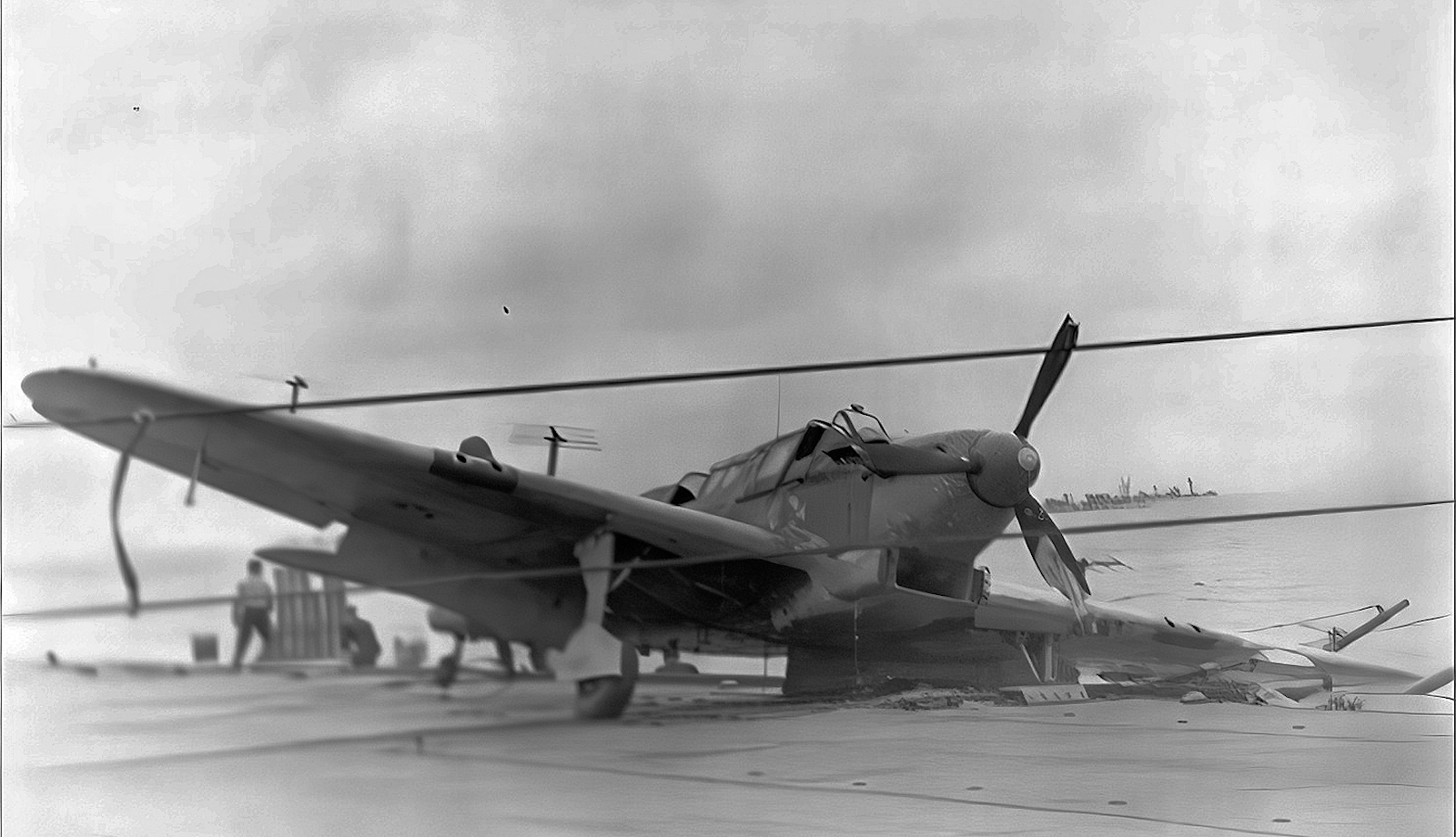
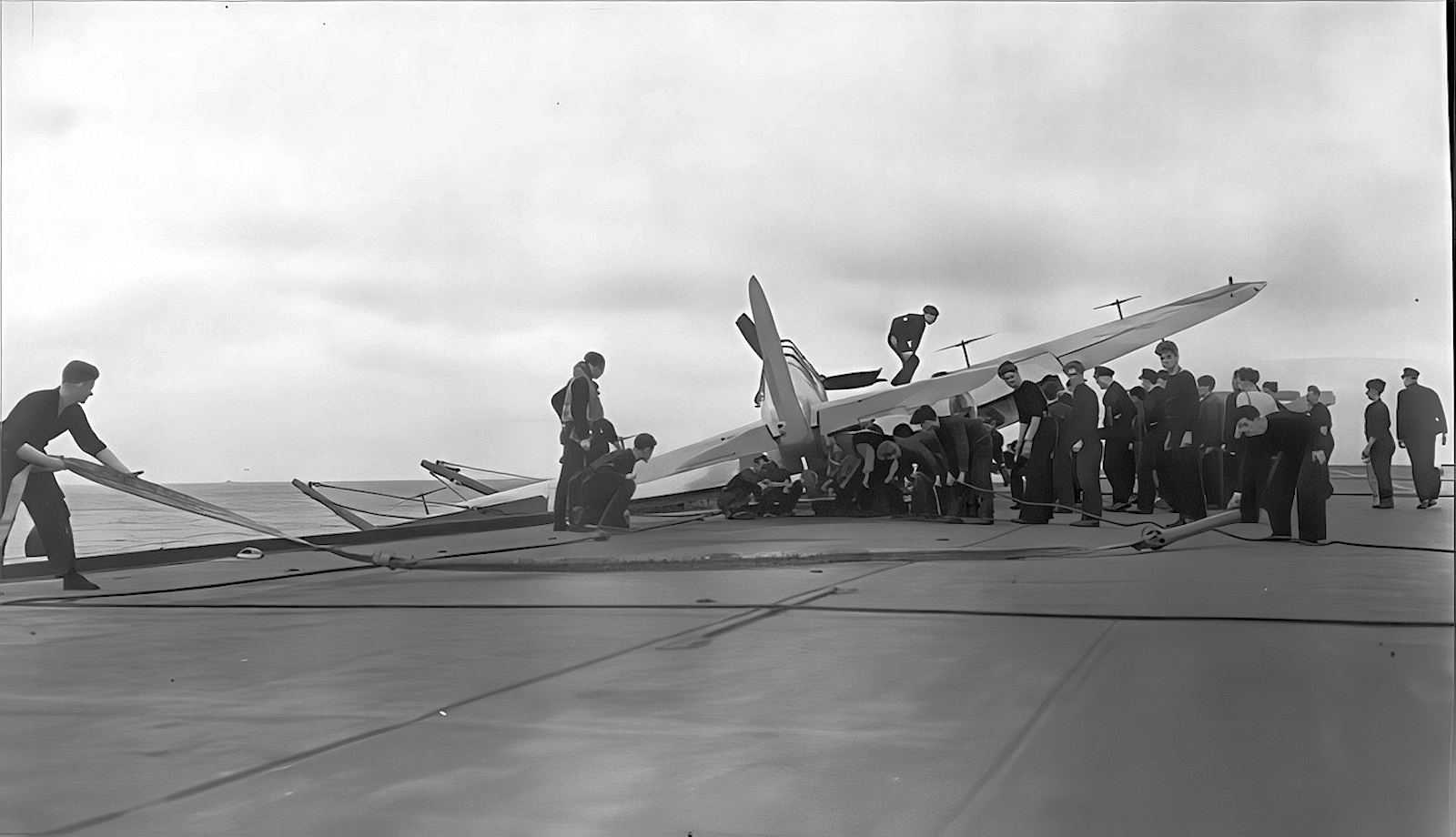
Training continued with joint exercises with the Submarine THOROUGH, beginning on the 21st, with VINDEX acting as the target vessel for simulated attacks. A second round of exercises was conducted on the 22nd, including at night. There were two flying incidents during this period, both involving Swordfish, on the 21st. LS416, piloted by Sub-Lt D. Ward RNVR, struck the bridge structure while taking off, the wing smashed the glass screens, showering the bridge staff with glass [1]. NE982 ditched over the side landing, and the crew, Lt R. E. Huggin RNVR, Sub-Lt P. T. Calcutt RNZNVR & Leading Airman F. Hampton, were rescued OK [2].
The Fulmars of 784 squadron left the ship on the 23rd. Flying training was concluded in the afternoon of the 24th, with one final incident, and the ship anchored to embark last-minute stores before sailing for Moville, Londonderry, to join the 9th Canadian Escort Group for her next operation. Swordfish patrols were flown on passage; NF115 ('R'), piloted by Sub-Lt R. E. Jordan, RNVR, hit the barrier landing that night.
VINDEX arrived off Moville in the forenoon of April 25th, and after a conference with the senior commanders of the 9EG on board, VINDEX weighed at 20:45 and set course for her next hunting ground. She was joined by her close escorts, the Canadian Frigates STORMONT and MATANE. They were joined by a third Frigate, HMCS SWANSEA at 06:00 on the 27th when the first Hurricane patrol was launched. Later that morning, three Frigates HM ships AYLMER, BICKERTON (S.O.) & BLIGH, the first division from 5EG were sighted and joined on VINDEX. Their commander requested fuel, and all three took turns to top off their reserves. The Hurricanes maintained their patrols, but no flying was possible for the Swordfish until 04:00 due to a lack of wind over the deck.
Flying operations continued without major incident until just after midnight on the 29th, when Swordfish NE868 ('Z’) ditched 15 miles from the ship due to water in the petrol. The crew, Sub-Lt R. J. Shaw RNVR, Sub-Lt M. G. Oakley RNVR & an unidentified Leading Airman were rescued by AYLMER. [3]
At midday on the 29th, the ships of 9EG were released and set course for their next assignment. They were replaced by the ships of the second division from 5EG GOODSON, KEATS and KEMPTHORNE. On May 4th, BICKERTON & BLIGH took turns to fuel from the Carrier. In the afternoon of May 5th, VINDEX conducted an experiment: with the Frigate AYLMER fuelling astern off her Port quarter, she successfully launched and recovered two Swordfish. This meant she no longer had to suspend flight operations while tending to her escorts.
At 16:30, a flight of three Hurricanes was launched for a U-boat search. At 18:00, one of these got into trouble about 70 miles from the ship. The pilot, Sub-Lt A. E. Martin RNZNVR, reported his engine was losing glycol coolant, was overheating and was turning back towards the ship. He was escorted by a fellow New Zealander, Sub-Lt J. Moore. At about 14 miles out, the engine gave up completely, and Sub-Lt Martin baled out at 3,000ft. At 18:25, a rescue Swordfish arrived over the scene where the remaining two Hurricanes had been circling and attempted to drop life rafts for the pilot to enter. The sea temperature had drained his strength, and he could not reach any of them. He was pulled from the water just after 19:00 by GOODSON, but died as a result of immersion for over an hour.p;
Later that evening, a surfaced U-Boat was discovered, unfortunately by a Swordfish which had just jettisoned its pair of depth charges in preparation for landing on the carrier. The crew circled the location while the other two aircraft aloft were vectored to their position. A third Swordfish launched at 22:40 to join the search, but by the time they arrived on scene, a heavy sea mist had begun to roll in, seriously reducing visibility. When the search was called off, all four aircraft were flying in fog and darkness, relying on their ASV radar to locate the ship. One aircraft landed with its engine coughing from a lack of fuel as it touched down.
Flying resumed at 03:30 om May 6th when Swordfish NE996 ('V') crewed by Sub-Lt F. O. B. Sheffield RNVR, Sub-Lt J. Vallely RNVR and CPO M. Dale took off to rendezvous with the frigate KEATS. The ship got a radar contact at 04:00, but the U-Boat slipped away. The Swordfish observer located the ships of 5EG at 05:00 and passed course details for them to join the hunt. At 05:18, BICKERTON (S.O. 5EG) picked up a confirmed submarine contact on asdic, some 2½ from KEATS. The three Frigates BICKERTON, BLIGH and AYLMER now began hunting the new contact. By 06:00, the trap was set, and BLIGH began fringing a pattern of 26 death charges; after 22 had been launched, severe vibration on the deck caused one charge to jump off the loading rails and damaged the thrower mechanism. Some charges went off prematurely, exploding near the ship and causing damage, but at 06:05, in position 52°30'N, 28°28'W, U-765 broke the surface. She showed signs of damage from the depth charges, and all three frigates opened fire on her. Meanwhile, Sub-Lt Sheffield turned his Swordfish to begin an attack run. Although taking damage from the submarine's anti-craft gun, he managed to straddle the U-Boat's conning tower with his two depth charges, 40 feet apart. The resulting explosions split the submarine in two, and both halves sank swiftly. This was VINDEX and 825 Squadron’s first U-boat kill; sadly, no images of this momentous occasion exist as the gunner, CPO Dale, forgot to take any in the heat of the action. The crew were all mentioned in despatches for this action.
The Atlantic weather began to deteriorate again during the day on May 6th, eventually building into a gale that lasted for 48 hours. Information gleaned from the few survivors of U-765 revealed that there was a second U-Boat in the area, part of a weather reporting network and Commander D. G. F. W. MacIntyre, DSO and 2 Bars, RN, the Senior Officer of the Fifth Escort Group, was determined to find it. Flying continued overnight on the 6/7th May, but was suspended when the sea state made the deck unsafe. An unexpected effect of the heavy sea state was that the carriers' petrol storage tanks had been severely agitated, and the water that had settled to the bottom had now been dispersed throughout the tanks. This discovery seriously hampered flight operations for the remainder of the operation, as all petrol had to be filtered before being allowed into the aircraft's tanks.
A more serious breakdown occurred on the morning of May 8th; the ship’s only aircraft lift broke down. The huge metal platform was raised and lowered by an electric motor, and its rate of ascent/descent was controlled by a large counterweight. The problem occurred when the cables connecting the counterweight to the lift platform began to stretch, causing the weight to reach the bottom of its travel before the lift reached deck level. This happened at 09:45; the disparity between the lift edge and weight meant that a switch that stops the motor could not be tripped, and the motor burned out while trying to push the platform up the last foot. There was no spare motor on board, but the engineering team replaced it with the capstan motor, a mammoth task which was to take 24 hours to complete. All aircraft movements into and out of the hangar were achieved by manually cranking the lift, a process which could take an hour. Flying continued, but most of the aircraft already in service had to remain on deck. On the morning of the breakdown, one swordfish, LS416 crewed by Lt G. Bennett RNVR, Sub-Lt P. S. Couch RNVR & Naval Airman J. J. Palmer, had to land with the lift stuck down, having to make use of a much shorter flight deck while VINDEX was refuelling KEATS astern.
The design of VINDEX and her sister British escort carriers allowed only a single lift aft. Not only was this problematic for landing on aircraft if the lift was stuck down, but the access to aircraft required for the morning range could involve the movement of 5 or 6 airframes up onto the flight deck before those actually required could be brought up -far less of a problem in the US-built CVEs with lifts forward and aft.
By May 10th, VINDEX was again in the position of holding only enough fuel reserves for her close escort, and the three Frigates of 5EG were detached to return to base at midday. VINDEX continued search operations flying through the night of 19th/11th; disaster struck at 03:30 when Swordfish NF121 ('M'), coming in to land on extreme wave, struck the deck with its starboard wing tip and careered down the deck before being swung heavily to starboard after snagging a wire and vanished over the deck edge. GOODSON, acting as plane guard, immediately went to the spot, and the carrier turned to return to join the search. Of the crew, only the observer, Sub-Lt J. Mcllwraith RNVR, was pulled from the water. The pilot, Sub-Lt D. Webb RNZNVR & PO Airman A.W. Mears, were not recovered. The search was called off at 06:30, and at 06:45, GOODSON reported that Sub-Lt McLlwraith had died. The weather worsened enough to suspend flying until the night of the 11th, but all searches were fruitless. At 09:00 on May 12th, Captain Bayliss set course for base, ending the ship’s second hunter-killer operation. She arrived on the Clyde on the morning of May 15th.
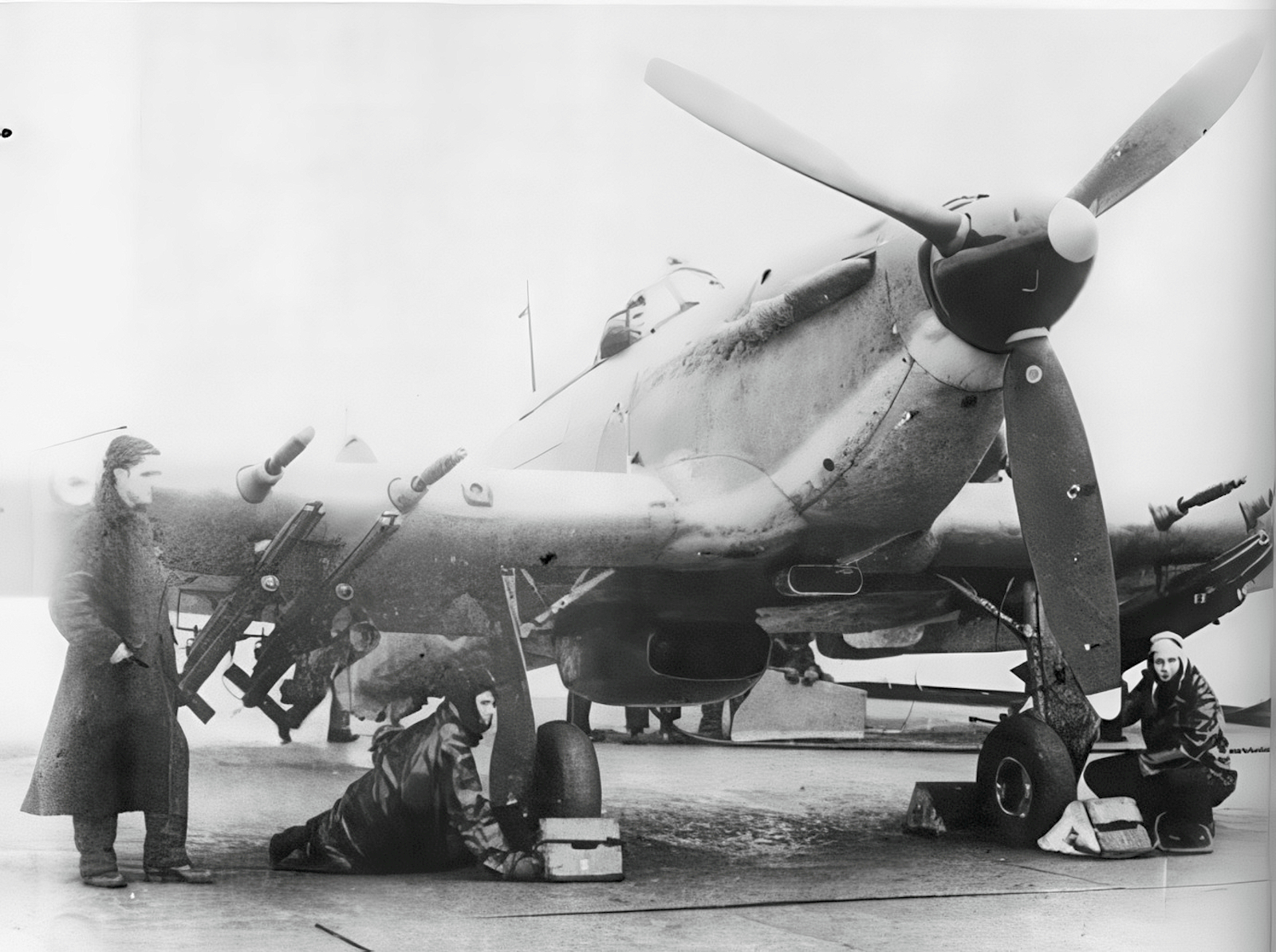
.jpg)
VINDEX was to spend the next six weeks making repairs and refining operational procedures. Cdr (E) H. N. Wear RNR, the ship’s engineer, discovered that the problem of water contamination in the aviation fuel was caused by the use of compressed air to pressurise the tanks, and he proposed a radical alternative system. The tanks were initially filled with seawater, and the aviation spirit was then pumped in, displacing the saltwater. The lighter petrol did not mix with the dense salt water, which remained at the bottom of the tanks. When petrol needed to be pumped to the flight deck, more seawater was pumped in to displace the petrol. Lt-Cdr Gick (Commander Flying) was also considering how to improve flight operations and devised a system to provide returning crews with adequate rest before being placed back in the active rotation. He modified a compartment next to the ready room, which was both soundproofed and air-conditioned, and fitted out with bunks, allowing newly returned crews to get a guaranteed minimum number of hours' rest before becoming available for further flights.
12 new Swordfish Mk.III were issued to 825 squadron from RNAS Abbotsinch on June 21st. This version was designed for night operations; it had been upgraded with a large centimetric ASV Mk.XI radar unit with a rotating scanner mounted in a large housing under the nose between the undercarriage struts, and featured a more powerful Pegasus XXX engine and could be launched using RATOG (Rocket Assisted Take Off Gear). The new machines were considerably heavier than the previous models, so the squadron TAGs were no longer carried; the observer took on the extra duties.
At the end of June, the ship returned to Lough Foyle to make final preparations to sail for her next Hunter-killer operation.
VINDEX sailed from Moville at 20:30 on July 1st, escorted by HM Frigates AWE, BULLEN, and GOODALL in company with the Corvette HMCS ST. THOMAS. The first Swordfish searches began at 09:15 on July 2nd, but the weather and visibility grounded them on the morning of the 3rd. The Destroyer BULLDOG joined the escort on the 3rd, Lt Cdr C. G. Walker, RN, assumed Senior Officer Escort. Flying resumed at 10:30 on the 4th, but fog closed in later that afternoon. The new squadron tasking required all 12 Swordfish to fly round the clock; however, the new radar was plagued by defects, many stemming from poor build quality and design flaws. The ship’s radar repair shop was hard-pressed to keep sufficient aircraft serviceable to meet the flying program. Flying was again abandoned with the return of the fog; the Corvette PEVENSEY CASTLE joined at tea time and the escort divided into two groups, BULLDOG, GOODALL and PEVENSEY CASTLE forming the close escort for VINDEX AWE, BULLEN and ST. THOMAS detached to operate as a hunting group moving out to 30 miles from the carrier. This formation was designated Force 34.
At 22:00 on the 6th, some 70 miles north of Scapa Flow, a pair of Sea Hurricanes were scrambled to search for a U-boat reported attacking fishing vessels west of Cape Wrath. The search was unsuccessful, but the pair discovered they had passed the point of no return and had insufficient fuel to return to VINDEX. Sub-Lt J. E. Moore RNZNVR in JS310 and Sub-Lt P. A. Hellyer RNVR in NF677 eventually made landfall and both safely belly-landed on a soccer pitch near Castletown; a squadron of Swordfish picked them up from RAF Thurso the next day. A large-scale hunt was mounted for this submarine with aircraft from the RAF and Rand the British Frigates BURGES and MANNERS, together with the Canadian Corvette HUNTSVILLE and ten A/S trawlers, were sailed and joined the search, which continued into the night of the 6th/7th, but without any confirmed contacts A tragic accident occurred on the 7th. FAA/FX 95074 Air Mechanic (L) A. T. W. Brown was killed while assisting the armourers with a circuit test on a Swordfish R/P loadout. The firing circuit leads were normally connected to a test bulb to show a completed circuit – a tired armourer had, however, plugged the rocket rail lead back in, not a bulb, and when the firing button was stressed in the cockpit, a rocket ignited, killing AM(L) Brown. The R/p flew down the length of the flight deck before hitting and badly damaging a Sea Hurricane in the aircraft park. No one else was injured.
Swordfish resumed search operations at 21:45, when three aircraft were ranged; however, one failed to launch due to water in the fuel tank. This should not have happened with the new pumping system; an overworked engineer, on duty for 6o hours and under the influence of fumes from the AVGAS had failed to set the valves correctly before fuelling began, and salt water was pumped to the flight deck instead of into the storage tanks. This contamination took several hours to correct. A second aircraft from the search returned early with its new ASV radar out of commission. The remaining aircraft continued its patrol and, just after midnight, got a good radar contact 40 miles southwest of the Carrier. Despite remaining on station and marking the spot, the surface ships could not find any trace. The aircraft landed with only 15 minutes of fuel remaining.
On May 8th, C-in-C Western Approaches signalled VINDEX, informing Captain Bayliss that the U-Boat would be passing to the north of Rockall, and orders were given for the four Frigates BULLEN, BURGES, GOODALL and MANNERS to establish a 60-mile patroil line on longitude 4⁰ West; however, a coding error had these ships out of position to the eastward when the submarine rounded Rockall. The weather deteriorated in the afternoon, and flying was suspended at 15:30, resuming at 20:00. The intensity of flying operations on this hunt meant the Carrier was burning through her Petrol stores faster than on previous operations. Captain Bayliss calculated he had only 3 more days before he had to withdraw to replenish. He planned to stretch this out to 4 days by reducing the Swordfish patrols from 3 to 2 aircraft.
On the morning of the 8th, a Swordfish acquired a solid radar contact, and the Frigates were vectored to the location. The submarine continued to evade the hunters, and it became clear that this one was using a snorkel to avoid running on the surface and was equipped with a radar-detection warning system. A savage gale and heavy fog developed next, and the scent was lost. Shifting position to the northeast on the morning of the 10th, the hunt resumed. Another setback now occurred, VINDEX was refuelling two of her escorts when the trailing hose parted at the carrier end and could not be recovered from the ship. BULLEN had received only 30 tons of oil when the hose parted, and attempts to salvage it resulted in it becoming tangled around her starboard propeller; only 3 usable lengths were eventually recovered and transferred to VINDEX. Orders were given for BULLEN and GOODALL to return to Liverpool. This left the Carrier with only MANNERS, PEVENSEY CASTLE and ST. THOMAS as her close escort.
A report now came in of an RAF Sunderland having attacked a U-Boat at periscope depth in position 058⁰ 31' N. 009⁰ 53’ W AT about 07:10. This was approximately 21 miles to her west-south-west of the Carrier. MANNERS was detailed to investigate, but her asdic set went unserviceable, so Captain Bayliss sent PEVENSEY CASTLE and ST. THOMAS instead, retain the Frigate as escort. More Swordfish patrols were now launched; by this time, the aircraft had been aloft for 60 hours - only a 5-hour break for bad weather on the 10th saw any respite. VINDEX now had 6 Swordfish circling the marker dropped by the Sunderland. Reinforcements were to arrive in the form of STRIKER carrying 824 Squadron; escorted by the Corvettes LAUNCESTON CASTLE and HMCS ARNPRIOR, she rendezvoused at 17:00 in position 58 ⁰34’ N 09⁰ 12’ W.
Originally, STRIKER was to relieve VINDEX, which was to return to the Clyde to replenish and sail a.m. on the 13th to re-join the Force. However, the plan changed: STRIKER was to take over all daylight flying operations, while VINDEX continued to cover night operations. This arrangement would help to stretch out her meagre petrol stocks and briefly extend her time on station. 825 Squadron conducted Searches through the night of the 11th/12th and again in the evening on the 12th. About midnight, the visibility dropped sharply, and all six aircraft aloft were recalled; four landed safely, but the fourth, NR876 ('M’), piloted by Sub-Lt D. A. Hook RNVR, crashed on deck, damaging the starboard oleo and slower wing. A fifth Swordfish failed to make it back to the ship; NR888, piloted by Sub-Lt R. L. Griffiths RNVR, was not visible on the carrier’s radar at the time of the recall, but the observer could see VINDEX on his ASV set and set course. Low on fuel in near complete darkness, the pilot struggled to locate the ship, and on the one occasion he did, he radioed that he was “crossing the end of your flarepath”. Contact was then lost; escort vessels reported hearing the aircraft pass overhead, but it failed to reappear for landing, having ditched when its engine cut out. Using what data was available to the ops room staff, an estimation of the ditching site was calculated, and MANNERS was dispatched to investigate. The guesswork was correct, and the crew were safely rescued.
VINDEX, escorted by the Corvettes LAUNCESTON CASTLE and HMCS ARNPRIOR parted company with STRIKER at 09:00 on the 13th in position 58⁰ N. 13⁰ 40' W. and set course for the Clyde. She anchored off Greenock at 10:00 on July 14th. In the fourteen days so far in this operation, her squadron had flown 360 hours. Despite locating two U-Boats the intensive hunt failed to destroy either.
VINDEX was to remain at Greenock for the remainder of the month, leave being granted to both watches while repairs and replenishment were carried out. She was back at sea at 07:45 on August 4th for flying exercises in the Clyde training area. The next morning, Captain Bayliss was ordered to form an improvised Force 31 to conduct a submarine hunt. She was joined by the Corvettes MORPETH CASTLE and HMCS PETROLIA at 11:30. Because of the short notice to sail, these two vessels were not yet fully worked up and still required calibration for their HF/DF, asdic and radar equipment. The Frigates BAZELY, BURGES, THIRLMERE, TILLSONBURG and WINDERMERE joined the Force as it made its way towards the hunting area. The first Swordfish sorties were launched at 07:34 on the morning of the 6th; this was the normal three-aircraft search team. Thick fog had descended by the time the aircraft was due to return, giving Commander (F) a chance to test the latest innovation for guiding aircraft back to the ship in adverse conditions. He had theorised that the Mk.XI ASV sets used on the Swordfish could be mounted on the Carrier to track incoming aircraft and provide bearing and distance information to the pilots. A set had been mounted, inverted, outboard, aft on the starboard side and could locate aircraft up to 8 miles from the ship and monitor them until they were 100 yards from the rounddown. Used in conjunction with flare floats and searchlights, all three aircraft landed safely. This system, named the Morrison Blind Approach System, after Sub-Ly J. K. Morrison RNVR, the ship’s Air Radio Officer who adapted the ASV setup, was adopted for all bad weather landings of aircraft equipped with R/T and a radio altimeter. The only other attempted flight was a scramble of two Hurricanes to intercept a bogey; they, too, had to be recalled when the cloud ceiling fell to 100 feet. The inexperienced crew of MORPETH CASTLE reported a contact, but quickly lost it. The search was called off and VINDEX set course for Scapa Flow, via Stornoway.
Escorted by MORPETH CASTLE, TILLSONBURG, and PETROLIA VINDEX disembarked 825 Squadron to RAF Stornoway on August 8th. The original orders had been to disembark the squadron Swordfish, as well as those of 842 Squadron, from FENCER, along with stores, equipment and maintenance personnel for a stay of 14 days. This appears to have been changed, as 825 were back aboard VINDEX on the 10th when she sailed for Scapa, arriving there the following day.
VINDEX was now allocated to participate in Operation VICTUAL as part of an escort force to give safe passage of convoys JW59 and RA59A between the United Kingdom and North Russia. The convoys were to be protected by a force comprised of CVEs VINDEX (Flag V.A. Tenth Cruiser Squadron), and STRIKER, Cruiser JAMAICA, 5 Destroyers from the Third Destroyer Flotilla MILNE, MARNE, METEOR, MUSKETEER, and CAPRICE, which formed the Heavy Escort, plus the ships of the Twentieth Escort Group, Destroyer WHITEHALL, Frigate LOCH DUNVEGAN, Sloops CYGNET, PEACOCK, KITE, KEPPEL, MERMAID, Corvettes BLUEBELL, CHARLOCK, DIANELLA, OXLIP, and HONEYSUCKLE.
At Scapa, Vice Admiral Dalrymple-Hamilton RN, Commanding, Tenth Cruiser Squadron, transferred his Flag from the Cruiser JAMAICA to VINDEX just before she left Scapa at 11:00 on the 16th in company with STRIKER and JAMAICA with a temporary escort of Destroyers comprising VOLAGE, ALGONQUIN, VERULAM, VIRAGO, SCOURGE, WHIRLWIND, and WRANGLER to rendezvous with the convoy on the 17th. The convoy of 33 ships of JW59 left Loch Ewe on August 15th under the escort of 20EG and was passing the Orkneys when VINDEX sailed.
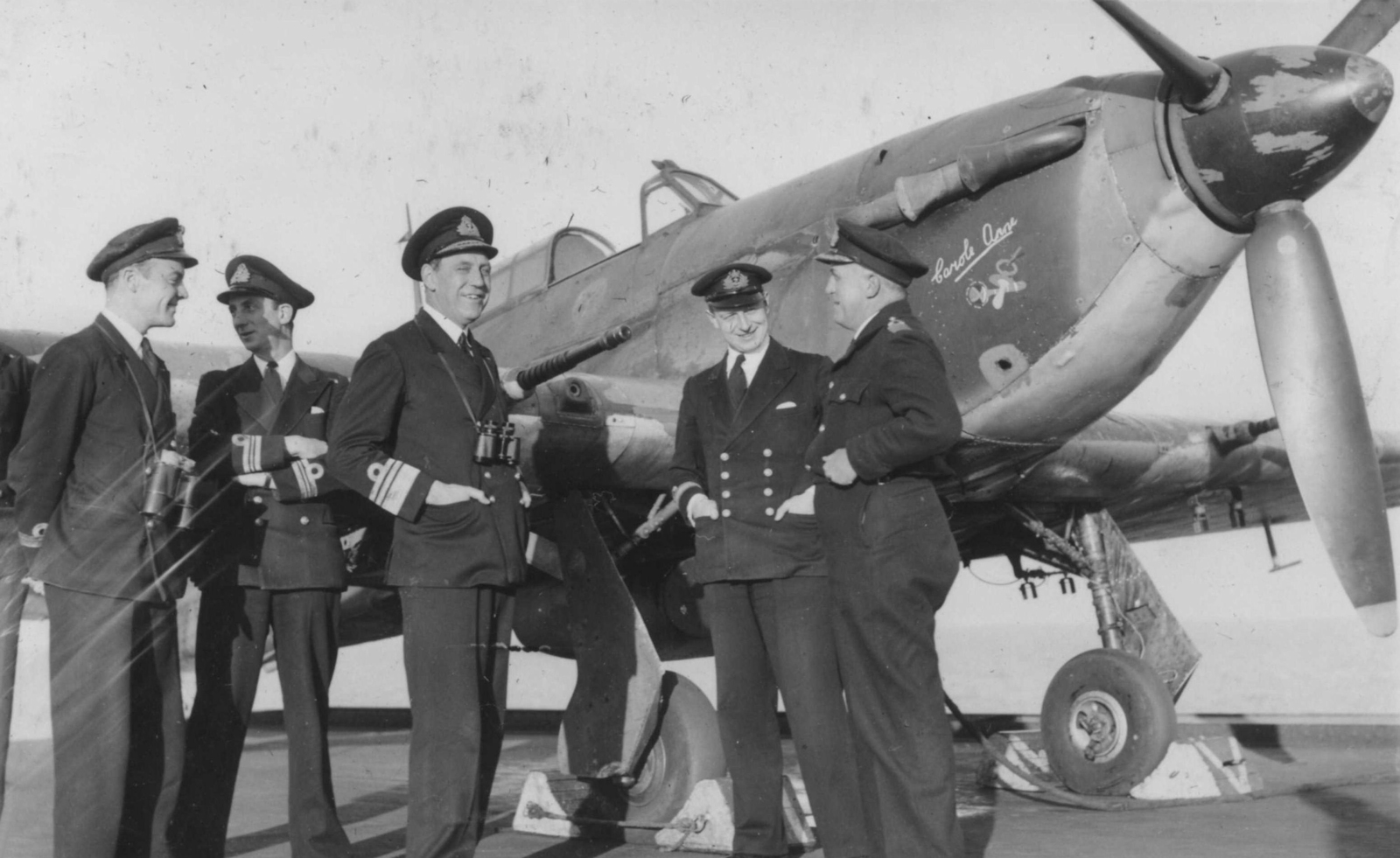
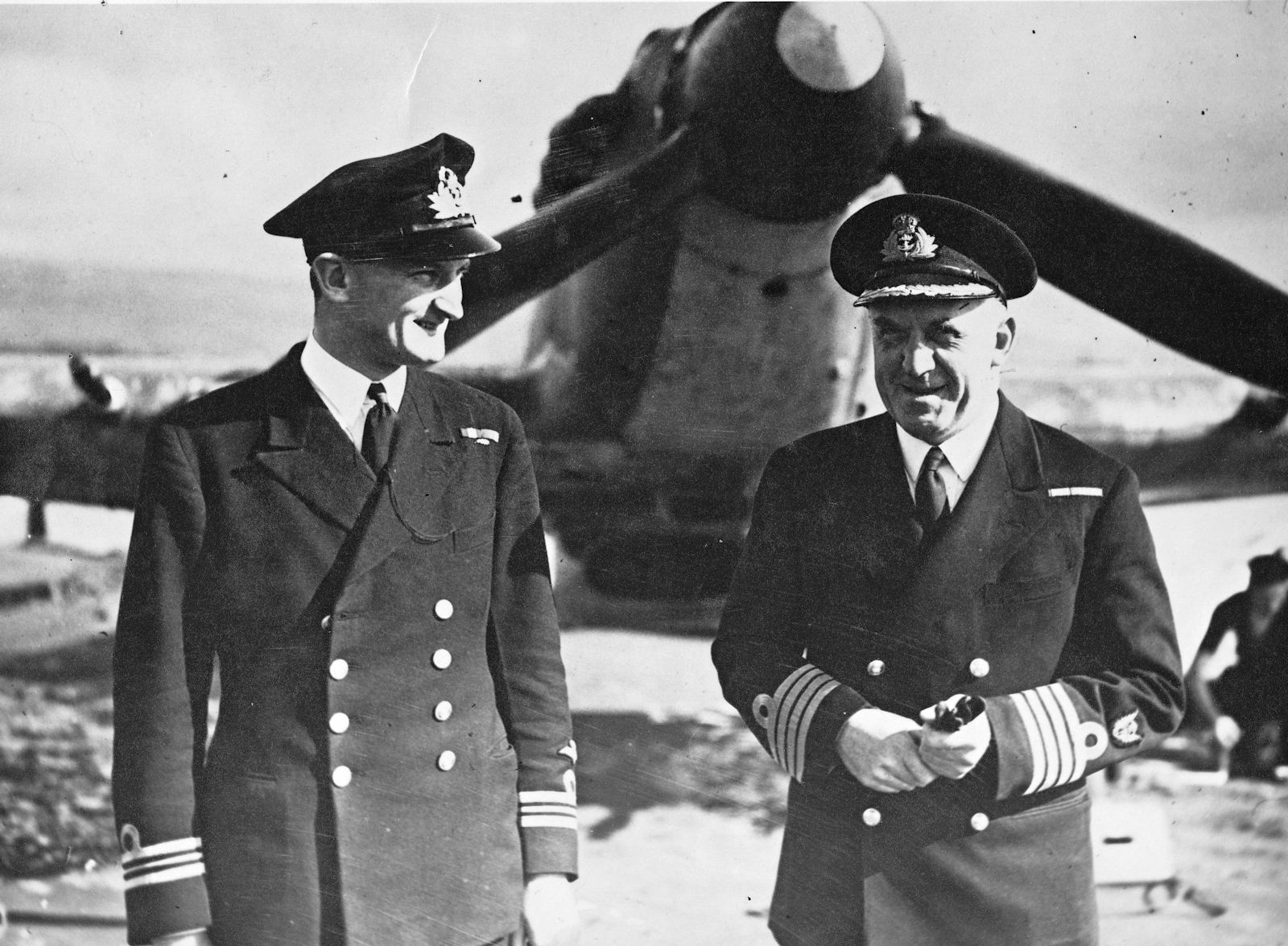
Vice Admiral Dalrymple-Hamilton, Flag Officer commanding the 10th Cruiser Squadron, on the flight deck with Captain Baylis (far right in battle dress) and senior officers in front of Sea Hurricane ‘Carole Anne’.
Shore-based air cover continued into the 17th, after which the two Carriers began providing A/S patrols. Fog once again became a hazard; at 17:00 on the 17th, all aircraft airborne had to land aboard VINDEX. The fog was so thick that STRIKER was not visible to the naked eye, and VINDEX recovered all aircraft using the Morrison Blind Approach System. Single Swordfish sorties were flown during the day from VINDEX on the 18th. At 07:20 on the 19th, her Type 281 radar picked up a strong aircraft signal, which was thought to be the German ‘Zenit’ weather reconnaissance plane out of Trondheim, Norway, which both carriers had been briefed on. Two Hurricanes from 825 were scrambled but failed to visually locate it – strict radio silence meant no vectors or other cues were given by the Air Direction Room; eventually, they returned to the ship. Another pair, plus two Wildcats from STRIKER, were aloft at 09:00 in an attempt to intercept it on its return flight, but neither caught sight of it.
On the 19th, the two carriers reverted to their specialised tasking; each would be the duty carrier: STRIKER from 10:00 covering daylight flights, and VINDEX from 22:00 covering night patrols. Just before 09:000 on the 20th, another aerial contact was acquired, but the fighters scrambled to intercept again failed to intercept the bogey. This was thought to be another weather reconnaissance aircraft, but was in fact a Ju88, which had reported the convoy’s position.
The air defence plan for convoy JW59 was different from that employed in previous Russian convoys; instead of only operating close-range A/S sweeps around the convoy, VINDEX and STRIKER, however, were to conduct A/S sweeps out to 80 miles, and after this last failed interception, it was assumed that the convoy had been detected and the two squadrons began hunting for U-Boats. The strict radio silence restriction was lifted for operational sorties. Convoy escorts were now reporting HF/DF contacts and aircraft and surface vessels investigated these, but no submarines were engaged.
On the 20th, another group joined the convoy: eight Destroyers being delivered to the Russian Navy under the Lend-Lease agreement. They were USSR ZARKIJ ex BRIGHTON, USSR DERZKIJ ex CHELSEA, USSR DEJATELNYJ ex CHURCHILL, USSR ZOSTKIJ ex GEORGETOWN, USSR ZGUCHIJ ex LEAMINGTON, USSR DRUZNYJ ex LINCOLN, USSR ZIVUCHIJ ex H RICHMOND, and USSR DOBLESTNYJ ex ROXBOROUGH, accompanied by the British Destroyer CASSANDRA. More escorts also joined on the 20th, the Battleship USSR ARCHANGEL (ex-ROYAL SOVEREIGN) flying the flag of Vice Admiral Levchenko, accompanied by the British Destroyers SCORPION, SERAPIS, and CAMBRIAN. In addition, ten Russian M.L.'s also sailed with the convoy.
At 06.40 on August 21st, in position 73º01'N, 03º57'E, the Sloop KITE was struck by two torpedoes on the starboard side and heeled over to that side immediately. She had slowed to 6 knots to clear her foxers, anti-acoustic torpedo decoys towed astern, which had become twisted together. At this vulnerable moment, U-344 fired a spread of three FAT torpedoes at the sloop, which had been misidentified as a Dido-class light cruiser by her commander. The stern broke off, floated for a few seconds, then sank. The bow remained afloat for a minute and then sank at a steep angle. By 20:00 it was clear that a U-Boat Wolfpack was closing in on the convoy, with multiple contacts in front and behind the convoy. Hurricanes from VINDEX were scrambled three times that evening to investigate contacts found by Swordfish from STRIKER. Although not equipped for night operations, two Wildcats were scrambled from STRIKER at 22:30 to chase down another, but they failed to locate it.
By the morning of August 22nd, the U-Boat' wolfpacks had arrived in force to harass the convoy. At 04:10 at position 74°55' N 13°50' E, a shadowing flying boat, a BV 138 was intercepted by a pair of Wildcats from STRIKER; JV476 ('Z'), flown by Sub-Lt T. D. Lucey RNVR, and JV589 ('R'), flown by Sub-Lt R. I. C. Dibben RNVR, attacked, and it dived vertically into the sea. No survivors were seen.
Later that morning at 08:30, a lone Swordfish returning to VINDEX sighted U-344, the boat that had sunk the KITE in position 74⁰25’N, 15°15’E; Swordfish NR857 ('X') crewed by Lt G. Bennett RNVR & Sub-Lt P. S. Couch RNVR, were flying at 2,200 feet when they spotted the submarine on the surface and attacked. They dropped three Depth Charges on reaching 50 feet, all set for a depth of 22 – 24 feet. These fell 150 feet apart, and two entered the water alongside the starboard side, one aft and one amidships. The third hit the foc’sle of the diving boat and rolled down the deck to lodge under a guide wire on the mine guard at the bow. When the submarine reached 24 feet below the surface, it exploded; the sub was completely crippled and began to sink fast. Only one survivor of her 50-strong crew was seen to have survived, but efforts to drop a semi-inflated dinghy failed when it got caught in the slipstream. Both the pilot and his observer were Mentioned in Despatches for their actions.
Swordfish from STRIKER made the next discovery at 11:00. Sub-Lt T. O. Hounslow RNVR in Swordfish ‘H’ located and shadowed a surfaced U-Boat some 68 miles southeast of the convoy, and 40 miles east of Bear Island, when a second U-Boat appeared 5 miles to the north. They were ordered to continue shadowing while an additional two Swordfish and three Wildcats were launched from STRIKER to support. Swordfish ‘B’ from 824 squadron was also directed to leave its search and join Sub-Lt Hounslow. VINDEX already had a flight of three Sea Hurricanes aloft: BX126 ('2F'), Sub-Lt Morre; NF732 ('2H'), Sub-Lt W. A. John RNVR; and JS272 ('2Q'), Sub-Lt P. A. Hellyer RNVR, and these were also vectored to the location.
On investigating the new U-Boat, Sub-Lt Hounslow and his crew came under A/A fire, and the submarine increased speed and eventually dived. His Swordfish was armed with an acoustic homing torpedo known as a ‘Fido’ or ‘B-Bomb’, which he armed and deployed ahead of the U-Boat's track. When it looked like the torpedo had failed to lock on, Swordfish ‘H’ dropped smoke floats and resumed shadowing the southern submarine. Next to arrive on the scene were VINDEX’s Hurricanes; from 3.500 feet they spotted the smoke floats and just beyond them a U-Boat on the surface. They manoeuvred to attack with the sun behind them and broke off to make three separate attack runs. Sub-Lt Hellyer attacked first, diving on the submarine's port beam. Despite heavy but inaccurate 20- and 40-mm fire, his cannons managed to silence the guns on the conning tower. He next attempted to fire his rockets, but nothing happened when he pressed the button, and he broke off. Sub-Lt Morre now came down and fired off four R/P, one of which appeared to strike the hull. Sub-Lt John made the final run coming in to attack over the port bow as the submarine was almost underwater; although his cannon shells appeared to hit home, his R/Ps went over by 20 – 30 feet. Out of the three Hurricanes, only BX126 ('2F') had a functioning gun camera, so images of the attack were very limited. A few minutes later, STRIKER’s Swordfish ‘B’ piloted by Sub-Lt T. H. Talbot RNVR, dropped another ‘Fido’ torpedo 25 yards to the port of where the periscope had vanished, followed by a smoke flare. Five minutes later, a fresh oil patch was seen spreading on the surface. At almost the same time as this frantic action was unfolding, another Swordfish from STRIKER located another U-Boat 50 miles south-southeast of the convoy; this one managed to dive before an attack could begin. Radio chatter from the German submarines now spiked after these sightings and attacks.
At 14:50, a STRIKER swordfish located another U-Boat, and 3 Hurricanes were launched from VINDEX, but the target had submerged by the time they reached its last known location. That afternoon, a pair of Swordfish from STRIKER ‘B’ & ‘L’ were ordered to search the area where the two U-boats had been seen in close proximity. At 15:00, they spotted a surfaced U-boat 12 miles distant on their starboard bow. On closing, it seemed to be trailing a large oil slick behind it, 5 miles long by 100 yards wide. The enemy submerged before Swordfish ‘F’ could close to R/P range, but Swordfish ‘B’ dropped a ‘Fido’ torpedo 100 yards ahead of the dive swell. There was no evidence that the ordnance had impacted. This pattern of contacts diving before attacks could be launched was becoming a problem; twice more Swordfish from 824 squadron located submarines, one 40 miles distant at 19:40 and the other at 80 miles at 20:50, both got away.
On taking over control of flying operations that evening at 21:30, VINDEX was expecting a busy night. Four Swordfish were initially launched, three conducting searches behind and abeam the convoy, the fourth tracking ahead. Less than half an hour later, an ASV ccontact was acquired by Swordfish NR865 (’Q’), crewed by ub-Lt E. RA Johnson RNVR and Sub-Lt M. Piercy RNVR, located some 13 miles to the southeast. Five minutes later, a submarine was seen steaming on the surface, but it had submerged by the time they arrived overhead. Having marked the spot with flares, the crew orbited the area at 400 feet for 40 minutes before another contact appeared 8 miles from the first and 40 miles southeast of the convoy. This boat also submerged and had been under for a good 20 seconds when a single depth charge was dropped in the swirl – it failed to detonate. Again, marker floats were dropped, and they began orbiting between the two dive points. A third U-Boat was sighted 8 miles from the second dive spot, but it disappeared at 4 miles, leaving an oil slick. Swordfish NR857 (‘L’) took off at 22:24 and, at 23:30, located a surfaced U-Boat 52 miles southeast of the convoy; rather than dive and sneak away, this commander decided to remain on the surface and opened up with 20- and 40-mm A/A guns. A pair of Hurricanes was scrambled from VINDEX to assist, but on detecting their approach on radar, the submarine submerged, and the fighters were recalled. Twenty seconds after it dove, the Swordfish pilot dropped a ‘Fido’ into the swirl but could only remain on station for another 20 minutes before low fuel called him back to the ship. An hour later, one of the relief Swordfish reached the location and reported seeing an oil slick and some floating debris.
At 02:15 on the 23rd, the convoy and escorts turned south after rounding Bear Island, which was now 35 miles off to their starboard. A new line of U-boats awaited them. WINDEX had Swedish patrols aloft at midnight in good visibility, far enough north to experience the polar, or ‘midnight’, sun, which was low on the horizon for much of the night. The first sighting was made by Swordfish NF244 crewed by Sub-Lt N. L. Sharrock RNVR and Sub-Lt A. C. Murrant RNVR; their attack was followed up by several depth charge patterns by escorts. There was no confirmed kill, but a 10-mile oil slick was later observed. At 03:03, Swordfish NR876 ('M’) crewed by Lt Bennett and Sub-Lt Couch, got an ASV contact nine miles of their starboard beam and only a few miles from the earlier sighting by Johnson and Piercy. IN the eerie light of the midnight sun, the U-Boat was clearly visible, and they closed to shadow it. As they drew nearer, anti-aircraft guns opened up; Lt Bennett now began a 20-minute dance with the submarine, which continued to expend large amounts of ammunition while he varied his height and range, both of which appeared to be underestimated by the German gunners. Eventually, he decided to make a quick attack run to drop a single depth charge. As he dropped below 1,800 feet on his approach, the submarine began to dive, so he revised his attack plan and selected all three depth charges, then dove steeply to drop them in the length of the swirl where the U-Boat had disappeared. All three detonated, and a large patch of oil and bubbles was observed along with some small pieces of wood. Now low on fuel, Lt Bennett had to leave the area and return to the ship. On landing, they had been in the air for 4 hours. Later, another aircraft returning from patrol reported seeing the same oil patch, as well as a yellow object the size of a football floating. This phenomenon was also reported later by a Swordfish from STRIKER.
Just after the convoy and escorts turned south, the USSR ARCHANGEL and her eight Lend-Lease Destroyers detached to proceed to Kola ahead of the convoy at 16 knots. The group was targeted by several U-Boats that had raced ahead of the convoy; U-711 fired two torpedoes at the ARCHANGEL and a third at her escort DERZKIJ. All exploded prematurely, but the Gerans tried to claim this as sunk.
Another Swordfish from VINDEX acquired a contact at 04:35. Sub-Lt R. E. Jordan RNVR and Sub-Lt G. Jenkins in NR861 (‘A’) got a weak contact 8 miles dead ahead; however, they could see the submarine on the surface, steering for the convoy some 60 miles to the southwest, and made their initial contact report. There was no immediate assistance available; the Frigate LOCH DUNVEGAN was nearest to their position, at 50 miles, so Sub-Lt Jordan began what was to be a repeat of the dance experienced by Bennett and Couch an hour earlier, keeping out of the angle of A/A fire for twenty minutes while getting into position for an R/P attack. VINDEX heard him start his attack dive, but then the radio went dead. Those in the Air Direction Room feared they had been shot down until 06:00, when radio contact was reestablished, when the aircraft was 5 miles from the Carrier returning from the patrol. ON landing, Jordan and Jenkins recounted their exploits; shrapnel from an exploding shell had fractured the serial crystal on their aircraft, and long-range communication was lost. They had attacked as the U-Boat submerged, but all of the R/Ps failed. Photographs taken of the submarine showed a new A/A mount on the conning tower, which was thought to be why the two ‘20-minute dances’ had been possible; the improved turrets were unable to track an aircraft flying as slowly as a Swordfish. The last launch before handing over control to STRIKER was at 07:30, when two Hurricanes were launched to intercept a bogey, which turned out to be a Russian-maned Catalina flying boat. In the past 24 hours, 825 Squadron had logged 127 flying hours.
Captain Crarne in STRIKER took over control as duty CVE at 09:00 and began launching his Mk.II Swordfish on patrols. At 13:45, one of these Swordfish crewed by Sub-Lt A. F. N. Turvey RNVR, Sub-Lt A. W. E. Lawrie RNVR and Naval Airman D. G. Harris got a radar contact on a U-boat on the surface heading for the convoy. They approached the submarine head-on, and initially the enemy opened fire with small arms fire before turning hard to port to bring their A.A. guns to bear. C turned to starboard and flew parallel to it. A short while later, when Sub-Lt Turvey steered towards it, the submarine again changed course, and the Swordfish was again flying parallel to it, with heavy A.A. fire starting up once it came to bear. Sub-Lt Turvey suspected this U-Boat was tasked with keeping contact with the convoy and was reluctant to break contact or to dive. When he next attempted to get ahead to approach the U-bout head-on, its fire abruptly ceased, and she began to dive. It had fully submerged by the time the Swordfish reached the spot, and three Depth charges were dropped from 60 feet, entering the water 50 to 70 yards ahead of the swirl and across the turn of the diving boat; oil and brown bubbles rose to the surface several minutes after the charges had detonated, and this was cautiously claimed as damaged. Heavy radio chatter from the U-boats was detected between 16:00 and 17:00.
VINDEX took over as the duty CVE at 18:10 and immediately launched four Swordfish, one of which had to return immediately due to engine trouble. At 19:10, a pair of Sea Hurricanes were scrambled, NF732 (‘H’) flown by Sub-Lt W. D. D. McDonald and NF680 (‘P’) flown by Sub-Lt D. R. Johnson, and were vectored to 55 miles west of the convoy, where HF/DF had located a suspected U-boat. On nearing the area, Sub-Lt Johnson spotted a shape 15 miles on his port beam, and as the distance shortened, they saw the dark shape split into two separate submarine shapes. The two aircraft broke formation. Sub-Lt McDonald turned to approach his target with the sun behind him; a mile and a half out, it began to dive. It was outside of cannon range, so he selected two R/Ps and attacked the swirl of the diving boat on its port quarter, hitting the water about a submarine length in front of the swirl. Meanwhile, Sub-Lt Johnson was attempting to enter a cloud to stalk the other U-boat, but this too began to dive before he was in position. He fired a full salvo of 4 R/Ps, which hit the water 15 seconds after the boat vanished beneath the surface, also about a submarine length ahead of the swirl. The fighters had to leave the area 5 minutes later, and there were no visible signs of damage. As a follow-up, Swordfish NR876 (‘M’), crewed by Lt Bennett and Sub-Lt Couch, was vectored to the location. They had a contact when nine miles out at 1.0000 feet, but his soon disappeared. Soon after, a snorkel was spotted, but it vanished too. Lt Bennett dropped a single depth charge with no result, then a float maker, before turning to return to the ship.
VINDEX now launched another of its experimental innovations, a pair of Swordfish armed to cover all eventualities, one with R/Ps, the other carrying an ‘Oscar’ and a depth charge to operate together. A second pair launched at 11:30, and they completed a three-hour patrol without incident. Two more took off at 01:25 on the morning of the 24th, but one, ‘Z’, crewed by Lt Bennett and Sub-Lt Couch, had to return with engine trouble. Swordfish ‘W' NR915, crewed by Sub-Lt R. J. Shaw RNVR & Sub-Lt J. Drysdale RNVR, continued on patrol. At 02:07, the Destroyer KEPPEL reported that a Gnat torpedo had narrowly missed her. 02:45, Sub-Lts Shaw and Drysdale sighted a surfaced U-boat 54 miles northeast of the convoy. As they approached the submarine, it opened fire, and VINDEX scrambled two Hurricanes to assist. Sub-Lt Shaw shadowed the target, which continued to mount a barrage of AA fire while zig-zagging to throw him off, lining up an attack. Sherly, after 03:00, with KEPPEL 10 miles out, Sub-Lt Shaw made his attack run; as it began, the U-boat dived, and a ripple of 6 R/Ps was launched, which straddled the boat, with the last pair hitting the water just in front of the swirl. Two probable hits were claimed, but the boat remained dived. The Hurricanes arrived on scene too late to add their firepower.
The escort Sloop MERMAID was nearing the attack site at 03:21 when her asdic operator got a strong contact 500 yards on her starboard beam. Her commanding officer, Lt Cdr J. P. Mosse, RN, immediately ordered speed reduced to 7 knots, to prepare for A/S sweeps and deploy the decoy ‘Foxers’. Almost immediately, a Gnat acoustic torpedo exploded close astern of her, followed one minute later by another. Had the U-boat firing the torpedoes been at a closer range, MERMAID would almost certainly have been sunk; her ‘Foxers’ were not deployed, and she was making best speed to the target area, the detonations were due to the extreme range, although homing once at the end of its run the gnat torpedo would have exploded in the wake of a vessel. She was joined by the Frigate LOCH DUNVEGAN, but it was not until 05:00 while the two ships were creeping along conducting an ‘observant’ search that a conning tower broke the surface. During such a slow manoeuvre, the U-boat could not detect the engine sounds, failed to spot them at 800 yards, and surfaced. An immediate asdic ‘ping’ was registered on MERMAID, and the submarine, U-354, crash dived. MERMAID made five depth charge patterns while LOCH DUNVEGAN fired her Squid mortars. Ten minutes after the last pattern had ended a delayed underwater explosion was felt, evidence of damage surfaced, including oil and a stream of bubbles, but contact remained, indicating the submarine was at various depths and speeds. The hunt was to last for several hours, Lt Cdr Mosse making attack runs at a pace his depth-charge loading party could not always maintain. While his throwers were being rearmed, he directed LOCH DUNVEGAN’s mortar, providing asdic and radar directions. KEPPEL joined them, making a depth charge attack at 11:15, followed by two more from MERMAID over the trail of oil bubbles. However, by mid-afternoon, MERMAID had exhausted her depth charges and was forced to withdraw by 16:00 without having a confirmed kill. Lt Cdr Mosse’s determination, however, had paid off; his target, U-354, was the same boat that crippled the CVE NABOB and sank the Destroyer BICKERTON two days earlier – she never returned to base. She is recorded as being sunk in position 72°49'N, 30°41'E.
There were no further contacts after the hunt for U-354, and the convoy and escorts arrived at the Kola inlet later that day, with additional cover provided by Soviet fighter aircraft. VINDEX and STRIKER anchored in Venga Bay at 00:30 on August 25th. The 16 merchant ships arrived at Kola inlet 05:55. On passage, 23 U-boats were sighted, though none were allowed closer than 40 miles from the convoy. The two carriers flew 444 hours in the U-boat area (20th to 24th August) and made 14 attacks. All sightings and attacks occurred at distances of 40 to 75 miles from the convoy. There were no casualties to aircrews or aircraft. One U-boat was destroyed and another possibly damaged by Swordfish from VINDEX, and one BV138 seaplane by Wildcats from STRIKER. The only vessel lost was KITE, torpedoed and sunk on the 22nd.
While at anchor awaiting the assembly of the return convoy, STRIKER played host to British and Russian sailors and Naval Officers, when a concert was held in the hangar; the entertainment included performances accompanied by a string quartet. A party was also held in the wardroom of VINDEX for a group of Russian naval officers. Local leave was granted, but the run ashore at Kola Inlet was quite a shock to the system - those who went ashore found there was nothing to do, and nowhere to go. Everyone had to stay on the road; deviation from the road brought attention from armed Soviet soldiers, many of whom were women.
The return convoy RA 59A for the voyage to Loch Ewe was much smaller, comprising only 9 merchant ships. VINDEX, STRIKER, JAMAICA and their escorts MILNE, MARNE, METEOR, MUSKETEER, and CAPRICE, sailed from Venga Bay at 14:00 on August 28th. Ships from 20EG escorted the convoy out, the Destroyer WHITEHALL, Sloops KEPPEL, PEACOCK, and MERMAID ahead as a striking group with the Frigate LOCH DUNVEGAN, Sloop CYGNET, Corvettes BLUEBELL, CAMELLIA, CHARLOCK, OXLIP, and HONEYSUCKLE as close escorts. When VINDEX (Flag CS10) and the heavy escort joined at 18:00, the escorts now took up their stations for the passage home.
The two Carriers now operate in 8-hour shifts as the controlling Carrier; STRIKER had control during rendezvous with the convoy, with VINDEX taking over at 22:00. The allocation of VINDEX to night operations was not as important at these latitudes; it was never dark when the sun did not set. As a precaution against the enemy having established their aircraft radio frequencies, all frequencies were changed, along with aircraft callsigns. To confuse any listeners, dummy traffic was broadcast on the old channels and call signs.
Progress was slow; one of the nine merchantmen could only manage 7 knots, and fog descended soon after sailing. No flying was possible until 04:15 the next morning, when VINDEX managed to launch a Swordfish. The weather closed in again shortly after its departure, and on its return at 07:40, it had to land with the aid of the Morrison Blind Approach System. This unique feature made VINDEX responsible for all search operations until the weather improved, which it did at 14:00, shortly after STRIKER took over as the controlling CVE. There were a few contacts on the 29th, and none that could be maintained long enough to investigate. STRIKER took over at 06:00 on the 30th, handing over to VINDEX at 14:00. There had been some U-boat transmissions picked up in the forenoon, and four Swordfish from 825 squadron were launched. ASV contacts were acquired at 12 and 36 miles southeast of the convoy. A surfaced U-boat sighting was made at 14:28, six miles off, making 8 knots, but the weather conditions, cloudy and windy, slowed down their approach, and the submarine had dived by the time they arrived. This contact was followed up an hour later by four Sea Hurricanes in the hope that the submarine had thought it safe to surface again, but there was no trace of her. On their return, the first aircraft sustained a serious barrier crash that fouled the deck, requiring STRIKER to accept the three aircraft in the landing circuit. [4]
Late on the 30th, a strong HF/Df signal located a U-boat off the convoy’s port bow, and the course was altered hard to port at midnight to avoid it. Soon after, another was detected on the port beam, and VINDEX launched three Swordfish at 06:00 on the 31st to seek it out, without success. Soon after their departure, the three Sea Hurricanes returned from STRIKER. The two carriers have now reverted to 12-hour on-duty turns as before.
Aircraft fatigue now began to set in for the 825 squadron, off four aircraft launched for the last patrol on the 31st, one returned with an unusable ASV set, another with engine trouble. On return from patrol in the early hours of September 1st, Sub-Lt Sharrock broke his safe landing run; he had 107 deck landings under his belt, this was his 32nd at night landing, however, on this night his aircraft, Swordfish NR858, hit the barrier, joining the ranks of the "shrap end club". [5]
At 08:45, a patrolling Swordfish spotted an oil patch in an area where HF/DF bearings indicated a U-Boat; in fact, there were two on the plot, one abeam and one astern of the convoy. STRIKER took over flying control at 09:00, and 35 minutes later, one of her Swordfish crewed by Sub-Lt P. G. Comber RNVR, Sub-Lt 0. W. Bishopp RNVR and Naval Airman J. R. Brynes, flying at 1.800 feet in a snowstorm, spotted a surfaced U-boat. The aircraft was spotted before reaching the optimal attack position, and the boat dived. Sub-Lt Comber pressed his attack, dropping 3 depth charges about 200 feet ahead of the swirl; the poor visibility ruined any photographs taken by Sub-Lt Bishop. The convoy altered course again at midday, bearing westward. Signals traffic in the afternoon and evening suggested there were still several U-boats in the area, mostly following. VINDEX took control at 21:00, and, as before, two of the four Swordfish launched had to return due to engine problems.
In the early hours of September 2nd, a flight of three Swordfish, led by 825 squadron C.O. Lt Cdr F. G. B. Sheffield RNVR, in NR887 ‘V’, took off for an offensive A/S sweep. At 06:10, his observer, Sub-Lt J. Valley received a new vector to steer for an HF/DF contact. Eighteen minutes later, they spotted a fully surfaced U-boat and relayed the sighting over the radio to VINDEX and the Striking Group, which was 25 miles away, and increased to full speed to try to intercept. The submarine began firing on the Swordfish as it approached. Lt Cdr Sheffield fired a single R/P from 500 feet and watched as the submarine blew her ballast tanks. He thought to crash dive, but she merely settled deeper in the water and continued to fire on him, turning as necessary to keep her weapons locked on. The next attack was a ripple of R/Ps fired from 800 feet at 800 yards; the U-boat gunners swiftly cleared the deck, and the submarine submerged. Lt Cdr Sheffield continued his attack dive and dropped two depth charges from 50 feet, entering the water 15 feet ahead of the swirl of the submerged boat. The charges failed to explode. A camera malfunction also prevented any photographs from being taken of the incident.
KEPPEL, WHITEHALL, PEACOCK, and MERMAID arrived on scene at 08:50 and began a box search. It was 11:17 before KEPPEL got a periscope sighting and ordered the group to close in. MERMAID got a firm asdic contact at 11:51. WHITEHALL opened fire with her forward Hedgehog mortar while MERMAID made a depth-charge run, followed by PEACOCK. The submarine made several course changes, and contact was lost and regained several times before an accurate location was established and the four ships began a creeping attack. The formation, MERMAID in the centre with KEPPEL to port and WHITEHALL to starboard, began their attack directed by PEACOCK. The two flanking ships fired 22 charges each, while MERMAID rolled 18 charges down her stern ramp, set for 500 and 850 feet. The attack was successful, and the boat, U-394, was destroyed.
Once the convoy cleared Bear Island and course was set for home, the U-boat threat appeared to be greatly diminished. VINDEX continued launching Swordfish patrols through the night of 2/3 September without contact. At 07:00 on the 3rd, four Sea Hurricanes were launched to intercept the ‘Zenit’ weather recon plane; they actually saw the JU88 this time, but could not catch up before reaching the limits of their endurance and had to return to base. Normally, such an incident would have prompted a report of the convoy’s position and a high probability of a dusk attack; this time, no attack followed. More mechanical problems plagued 825 that night; at 03:00, a pair of Swordfish were launched for local patrol, but both developed engine trouble. Swordfish ('Y'), crewed by Sub-Lts Johnson & Piercy, began losing oil pressure after take-off and were ordered to make an emergency night landing. On landing, the aircraft drifted to starboard, and it struck the island structure, caught fire, and fell overboard, hitting the sea upside down. The pilot emerged straightaway, but the observer had been concussed by the impact and did not regain consciousness until underwater. After freeing himself, he finally managed to reach the surface. VINDEX had performed an emergency stop and sent a boat to pick up the two aviators. The second aircraft, crewed by Sub-Lt R. E. Jordan RNVR and Sub-Lt G. Jenldns RNVR, had an issue with one engine cylinder glowing red hot, but was ordered to continue its patrol – the 9-cylinder, air-cooled radial engine could continue operating even with one or more damaged cylinders. They continued their search for three hours with their ailing engine but landed safely.
In the afternoon of the 4th, there was a serious crash on deck. Sub-Lt Moore was making a normal approach to land in Sea Hurricane BX126 ('2F') when the stern rose sharply in the swell as he cut his engine and his aircraft bounced back into the air, missed all the wires, and the undercarriage was torn off by the crash barrier. It then smashed into the aircraft park forward; his own machine broke into two, separating just behind the cockpit and damaged another Sea Hurricane and two Swordfish. Sub-Lt Moore was OK. [6]
.jpg)
The aircrews of 825 squadron on the ships’ return to Greenock after escorting the convoys JW59 and RA59A. With them are Lieut Cdr F Stovin-Bradford RN, Commander of Operations on the Carrier, and Lieut Cdr P. D. Gick, RN, Commander Flying.
VINDEX and the other vessels of the Heavy Escort detached from the convoy and her escorts in the forenoon of September 5th, arriving at Scapa at 16:30 that afternoon. The Flag of Vice Admiral Commanding, Tenth Cruiser Squadron, transferred back to JAMAICA. After fuelling, VINDEX sailed for the Clyde on the 6th, and all serviceable aircraft were flown ashore to RNAS Machrihanish on the 7th as the ship approached the Clyde estuary.
It was planned that, with the departure of 824 squadron after 8 months on board, VINDEX would receive a new composite squadron before her next operation. This was to be 811 squadron, which had previously operated for a year in the CVE BITER equipped with 12 Swordfish Mk.III and a fighter flight of 4 Wildcat Mk.VI.Having
On the night of September 25th, VINDEX had another collision with a nearby vessel when her merchant anchors failed to hold her. High winds had caused her anchors to drag, and in the dark, she silently drifted. At 06:00 on the 26th, she collided with the liner QUEEN MARY and scraped her hull along the liner's starboard side. When the drift had been arrested, the damage to her port gun mounts and sponsons was bad enough to require time in a local dockyard to be repaired.
While in the dockyard, the maintenance personnel. stores and equipment of 811 squadron were embarked. VINDEX put to sea on September 30th to begin her flying workup, the 12 Swordfish Mk.IIIs flying out from RAF Limavady to join her in the Irish Sea. A week later, a fighter flight of 4 Wildcat Vis flew out from Edginton on October 6th. The workup program went well, with no major issues or incidents; one barrier crash was recorded on the 12th. Sub-Lt D. W. Vance RNVR made an emergency landing in Wildcat JV709 and hit the barrier. The ship was signed off by FOCT staff and sailed for Scapa on October 14th. She met with and took passage with the ships of the 21st Escort Group, arriving there on the 15th to join the assembling escort for the Arctic convoy JW 61, codenamed Operation TRIAL.
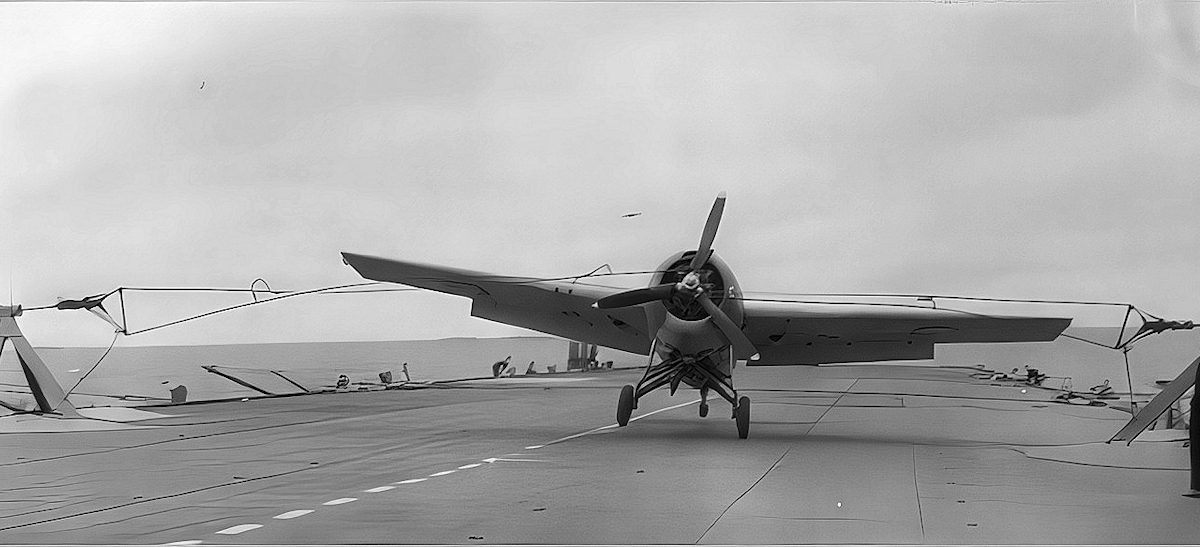
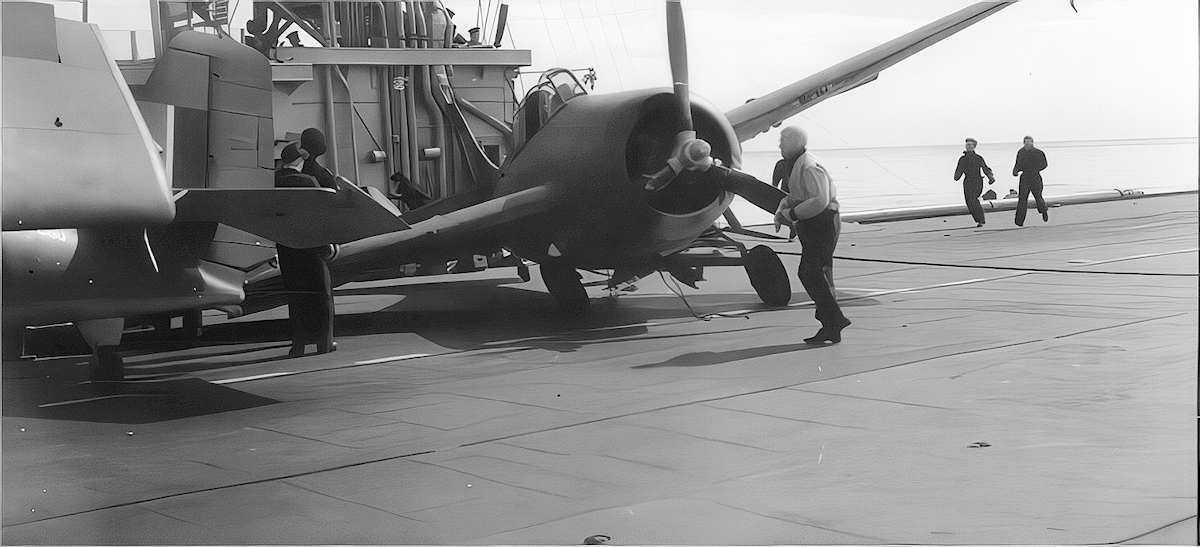
There were to be three escort carriers sailing with this convoy, VINDEX (811 Sqn, 12 Swordfish & 4 Wildcat), NAIRANA (835 Sqn, 14 Swordfish & 4 Wildcat) and the American-built TRACKER (853 Sqn, 10 Avenger, & 6 Wildcats).
The covering force comprised the following vessels: Heavy escort –Cruiser DIDO, CVEs NAIRANA, TRACKER and VINDEX (Flag CS10), screened by the 15th escort group, Frigates INGLIS, LAWSON, LORING, LOUIS, NARBOROUGH, and MOUNSEY. Additional escorts were provided by the 7th Destroyer Flotilla, ORWELL, ORIBI, OPPORTUNE, OFFA, OBEDIENT. Close escorts were provided by the 8th Escort Group, Sloops LARK and LAPWING, Destroyer WALKER, Corvettes CAMELLIA, OXLIP, and RHODODENDRON, and the 21st Escort Group Frigates BYRON, CONN (S.O.), DEANE, FITZROY, REDMILL, and RUPERT. The 32-merchant-vessel convoy JW 61 sailed from Loch Ewe on the 20th, escorted by the ships of the 8th Escort Group. The carriers and the other escorts sailed from Scapa at 13:00 on October 21st to rendezvous with the convoy. This was achieved at 09:30 on the 23rd.
The three carriers were to operate in 8-hour shifts, with the duty CVE maintaining standing searches while the standby CVE launched additional aircraft as needed. The third CVE was resting their aircrew and operations personnel. The Arctic day was much shorter now than when VINDEX had last sailed north, and true night flying was required to maintain cover. Only the two British-built carriers were equipped for night flying, so TRACKER was always on duty as a CVE in the daylight hours, NAIRANA and VINDEX covered half the dark hours each.
&The first fighter launch from VINDEX was on the 26th. Two of 811 Squadron’s Wildcats were scrambled at 10:15, but the bogey turned out to be a friendly Catalina flying boat. The first indication of U-boat activity was detected by HF/DF around midnight, and the convoy altered course to avoid the area where the transmissions had originated. Ships from the escort groups were detached to go hunting. An Avenger from TRACKER sighted the first U-boat on the 27th, some 40 miles off the convoy’s starboard quarter. The pilot dropped a ‘Oscar’, but it failed to detonate. Tragedy struck at 00:05 on October 28th, Lt D. L. Walsh RNVR and Sub-Lt W. E. Carr RNVR, returning from an A/S patrol in Swordfish NR914 ('H’) was waved off on attempting to land but continued to lose height as the aircraft flew up the starboard side of the ship before it crashed into the sea level with the island. VINDEX dropped marine markers overboard and called up the plane guard Destroyer OPPORTUNE as it began a turn to starboard to launch a whaler. At this point, Admiral Dalrymple-Hamilton came on the bridge and overrode Captain Batliss, ordering him to resume course and station and leave the rescue to OPPORTUNE. It was 01:30 before VINDEX received the message that Lt Walsh‘s body had been recovered, but there was no sign of Sub-Lt Carr. This incident was a harsh reminder of the realities of night flying in U-boat-infested Arctic waters, escorting a convoy; Captain Bayliss could hear the men in the water, but his standing orders were to maintain station with the convoy and let the rescue ship do its job. In these waters, the life expectancy of an airman in the water was 20 minutes. Had VINDEX reduced speed or stopped to recover them, she would have been an easy target for torpedo attack.
The majority of the U-boats had massed near the approaches to the Kola inlet, but the sheer number of three carriers with 50 aircraft available, 24 escort vessels, and Russian air patrols kept these threats at bay, and JW 61 arrived at the Kola inlet at 09:00 on the 28th without loss.
The three carriers anchored in Vaenga Bay until 11:45 on November 2nd when the escort force sailed to meet the UK convoy RA61. The U-boats were waiting for them. Shortly after clearing the inlet on course to the rendezvous, VINDEX’s asdic operators detected an incoming torpedo heading for the ship’s port bow. Captain Bayliss ordered an emergency turn to port, and the torpedo missed. Later that day, the Frigate MOUNSEY was not so lucky; she was hit by a Gnat torpedo fired by German U-boat U-295; the damage sustained forced her to return to the Kola Inlet for temporary repairs. She took passage in convoy RA-62 and underwent permanent repairs. In the UK.
There were several heavy landings resulting in damaged undercarriages and two deck crashes on November 3rd; the squadron C.O., Lt Cdr E. E. G. Emsley RNVR entered the barrier during a night landing, but at 21:20, Swordfish NR922 ('G') overcorrected in response to the batsman indicating his port wing was too low, and the aircraft slewed to starboard and fell over the deck edge. On its journey across the deck, the arrestor hook snagged no. 3 wire, and the aircraft hung over the water, suspended from the arrester wire for a short time before the hook gave way, and it plunged into the sea. The pilot, Sub-Lt J F. Bowden RNVR, was rescued by VINDEX, but the observer, Sub-Lt D. Evans RNVR, was not found despite a search by OPPORTUNE. [7] The plane guard Destroyer was in action again on the 7th when Swordfish NR873 ('F’), piloted by Sub-Lt A. D. Arcus RNZNVR, ditched in front of the ship after one of its RATOG packs failed to correctly ignite and the aircraft lost height on leaving the deck. The Destroyer was on station, and the crew was rescued within 2 minutes of takeoff.
Two of the ship’s 4 Wildcat fighters were out of commission on November 8th, while turning into the wind in preparation for launching and recovering Swordfish patrols, a sudden swell caught the carrier, and she heeled hard over to port. The sudden shift caused the standard lashing on two Wildcats parked aft on the flight deck to fail. Both (unidentified) aircraft now broke free, and one rolled off the flight deck into the sea, the other careered down the deck and flipped onto its back, coming to rest in the middle of the deck. Captain Bayliss had by now concluded the 811 squadron was not sufficiently trained in night flying, and air operations were to be reduced to a minimum for the rest of the voyage home.
The Heavy Escort detached from RA 61 on the 8th and arrived at Scapa on the 9th. Admiral Dalrymple-Hamilton transferred his flag to DIADEM. Later that day, NAIRANA, TRACKER and VINDEX sailed for the Clyde.
On arriving on the Clyde on the 10th, VINDEX prepared to send her crew on leave and begin work on voyage repairs. The Carrier was to remain on the Clyde for the next six and a half weeks, preparing for her next operation. Once repairs had been completed, VINDEX appears to have put to sea around November 21st to give high flying training to 811 squadron Swordfish pilots. [8]
In view of the ongoing training of the 811 squadron, the decision had been taken to reunite the ship with the most successful night-flying squadron, 825 NAS. 811-squadron left VINDEX on December 9th, flying ashore to RNAS Maydown; the Admiralty had decided to disband the squadron, and it was officially disbanded on arrival. Three days later, the 12 Swordfish III of 825 re-embarked on December 11th, flying out from RAF Mullaghmore, Northern Ireland. Four days later, they were joined by their fighter flight of 8 Wildcat VIs from RNAS Eglinton. A short work-up now followed by training in the Clyde exercise area. There are two recorded landing incidents during this period; On December 12th, Wildcat JV655, piloted by Sub-Lt G. V. Richards, entered the barrier after his arrester hook bounced and he floated over all the wires. On the 18th, sub-Lt S. T. Jenkins RNZNVR made a fast approach during a deck landing training session in Swordfish NR861 ('A') and entered the barrier. On Christmas Eve, the weather closed in in the late afternoon, heavy fog had descended, and the ship anchored off Rothsay. At 16:00, the captain knew that a short leave period over the holiday was a much-needed morale builder, so at 20:00, he took the ship slowly upriver, relying on radar and skilled navigation. When dawn broke on Christmas Day, the fog had lifted, and VINDEX was anchored 20 yards from her assigned berth. A short local leave was granted, but the ship was under sailing orders and due to depart for Scapa on the 26th. She sailed on time and arrived at Scapa on the 27th.
For this convoy escort, VINDEX was the only air asset available; Vice Admiral Dalrymple-Hamilton transferred his Flag from DIADEM on the 31st, and she sailed at midday.
The escort force assembled at Scapa comprised the CVE VINDEX (Flag CS10), the Cruiser DIADEM, and the Home Fleet Destroyers ALGONQUIN (RCN), MYNGS (D20), SAVAGE, SCORPION, SCOURGE, SERAPIS, SIOUX (RCN), STORD (Norway), ZAMBESI, and ZEBRA. This 39-merchant-ship convoy departed Loch Ewe on December 30th 1944, escorted by elements of the 7th & 8th escort groups; the Sloop CYGNE (S.O. 7th EG) T, LAPWING, LARK (S.O. 8th EG), Destroyers KEPPEL, WALKER and WESTCOTT, and corvettes ALINGTON CASTLE, BAMBOROUGH CASTLE, and ALNWICK CASTLE.
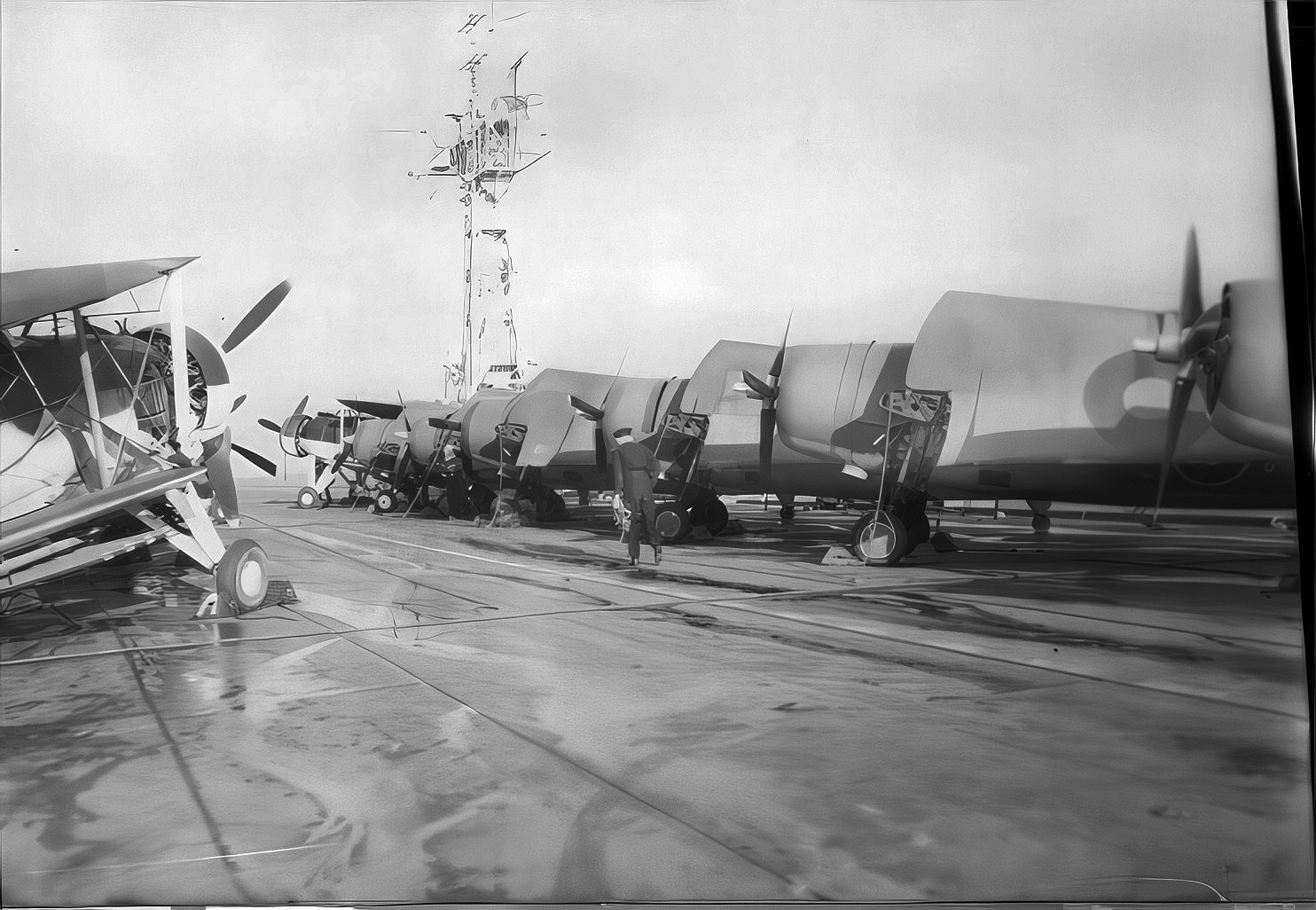
The aircraft of 825 squadron parked along the sides of the flight deck. Six of the eight Wildcats are visible down the starboard side, a number of Swordfish are also visible. C. December 1945..
U-boat activity had been reported in the Scapa area, so Swordfish patrols were launched at 14:20 to patrol ahead. The Scapa force made contact with the convoy at 11:15 on January 1st 1945, and VINDEX was on station by 12:45. There was no enemy contact until the morning of the 3rd, when two aerial bogeys were detected. The first showed up on radar at 10:05 and approached within 19 miles before disappearing. The second at 11:45 was at 12 miles west-south-west of the convoy, and two Wildcats were scrambled. The snooper closed to 6 miles before veering off. The fighter failed to locate him and landed at 12:10; however, DIADEM reported sighting a BV138. The assumption was that the snooper must have spouted and reported the convoy, so two fighters were now ranged on deck, a readiness to be scrambled should any other aircraft approach. They were launched again at 14:00 but returned without any success. Flying was no conducted in near total darkness, due to the "Polar Night," where the sun stays below the horizon for weeks. The convoy continued on course without incident until January 5th, when it entered an area where U-boats were thought to be waiting. 825 Squadron began operating Swordfish A/S searches in pairs: one pair ahead of the convoy, another astern. All flying was suspended at 16:30; the sea state had become quite lively, and two of the returning Swordfish had deck crashes. NR885, piloted by Sub-Lt M. S. White RNVR, stalled landing in gusty conditions and skidded to port; the undercarriage leg dropped over the deck edge and broke the aircraft’s back. NR876, piloted by Sub-Lt S. T. Jenkins RNZNVR, caught an arrester wire, but the hook gave way, and the undercarriage collapsed. It was not until 07:45 on the 6th that flying resumed, but was suspended again at 05:35 on the 7th when the weather worsened, and all aircraft were recalled. Sub-Lt R. L. Griffiths RNVR in Swordfish NR997 entered the barrier on landing. VINDEX, escorted by 4 destroyers, detached at 13:00 and moored in No. 48 berth, Vedanga Bay at 18:30.
The return convoy RA 63 of 33-merchant-ships sailed on the morning of January 11th, and U-boat activity was detected straightaway. HF/DF detected radio traffic even before the convoy had finished assembling, and escort vessels dropped a pattern of depth charges on a suspected target. VINDEX flew off one Swordfish on patrol at 10:40; this was relieved by a pair launched at 13:00. Patrolling pairs were maintained until midnight, when the ship’s arrester wire system malfunctioned. The last aircraft to land was NR878 at 21:45; it ballooned over the rounddown and caught the trickle wire, and the starboard wingtip hit the barrier stanchion. The crew, Sub-Lt P. E. Cumberland RNVR and Sub-Lt F. R. Jackson RNVR, were OK. Repairs to the flight deck machinery prevented flying until 05:30, but the resumption of patrols was short-lived as the weather began to close in. Flying was impossible with visibility down to 300 yards in driving snow. Conditions for aircraft handling parties were now becoming dangerous; aircraft on deck had to be secured with extra lashings, and personnel were secured with safety lines attached to the arrestor wires or a central line strung across the deck.
There was no flying on the 13th or 14th; however, three Wildcats were kept on deck at readiness to launch if any snoopers or attackers approached. The already terrible weather has now developed into a full gale moving in from the northeast, bringing heavy snow and rough seas. The convoy turned beam onto the swell, and VINDEX recorded a roll of 33½°. The convoy made slow progress, but the weather grounded land-based torpedo bombers; the threat from submarines remained very real. The first U—boat was detected by HF/DF at 21:00 on the 15th, which indicated it was 30 miles from the convoy. A small window in the weather opened at 02:00 on the 16th, and two Swordfish took off on a patrol; these, however, returned after only two hours as the weather was worsening again. In the forenoon, weather reports now warned that the gale was strengthening to hurricane-force levels and would cross the convoy's path. By 20:00, conditions were so severe that the escorts could no longer maintain a course and hove to. VINDEX was forced to do the same by 21:20. At dawn on the 17th, the Convoy Commodore reported only 7 of the 33 vessels were still in sight; the rest had been scattered through the night, some having fallen behind with mechanical issues. By 09:00, the wind had dropped to 42 knots, and Captain Baylis decided to turn and attempt to overtake the convoy. The Carrier had suffered some damage during the night, and the severe pitching and rolling had caused furniture in the wardroom to break free of its lashings, and the dining tables and piano had been smashed against the bulkheads. The escorts still struggled to keep up with VINDEX as she made 10 knots, as CS10 set a course for the Faeroes, where all ships were to rendezvous. VINDEX was able to launch three Swordfish at 09:40 on the 18th to search for stragglers and passed instructions to any located, by light, to proceed to Thorshaven. Despite more snowstorms while they were airborne, these aircraft were safely recovered before VINDEX, in company with DIADEM and escorts MYNGS, WESTCOTT, SCOURGE, SCORPION, SAVAGE, STORD, SERAPIS, LAPWING, ALNWICK CASTIE, CYGNET, ZEBRA, ZAMBESI, and approximately 25 merchantmen of the dispersed convoy RA 63 arrived at Thorshaven, in the Faeroes, at 11:30 on the 18th. The remaining escorts and convoy stragglers were expected to follow up within 24 hours. After anchoring at 14:30, Vice Admiral Dalrymple-Hamilton transferred his flag to DIADEM.
VINDEX sailed for Scapa on the 20th, calling there for only a few hours before proceeding to the Clyde. On arrival on the 21st, the Carrier berthed off Greenock and prepared to enter a dockyard for a refit. Operation GREYSTOKE was completed without loss, but this was almost certainly due to severe weather that hampered both the convoy and the German forces. This clean sheet wasn't to be repeated on the next run north; condemned HOTBED met with renewed enemy activity.
825 disembarked at RNAS Machrihanish on January 27th, and the ship entered a Clyde dockyard to begin her refit. She entered dry dock on March 2nd. The work took 2 months to complete, and the crew went on leave and attended training courses. The ship began engine trials on the Clyde on April 5th. Three days later, she embarked her third composite squadron in preparation for Operation ROUNDEL, escorting the convoy JW 66/RA 66 to northern Russia. This was 813 squadron, which flew out from RNAS Machrihanishon April 8th. Like 825, the squadron operated 12 Swordfish III and 8 Wildcat VI; their Swordfish were equipped with the new sonobuoy technology, which allowed them to track submerged U-boats and locate them on the surface using their ASV radar. Once safely on board, the ship began a short workup in the Clyde training area, anchoring at Lamlash each night.
The flying workout went well with only two incidents. On the first day of deck landing training, Swordfish NR971 ('GA'), piloted by Sub-Lt D. K. Brook RNVR, making a dusk landing, damaged the arrester hook, tailwheel and starboard undercarriage leg. On April 14th, Swordfish NR993 ('GP') struck the rounddown, making a night landing, and the aircraft fell into the sea on the starboard quarter. The crew, Sub-Lt G. D. Brierley and Sub-Lt R. A. Carter RNVR, were safely rescued. On completion of her workup, VINDEX returned to a mooring at Greenock, where Rear Admiral Cunninghame Graham, CBE (CS 10) transferred his flag from DIADEM on April 17th. She now adjusted her aircraft complement; 813 disembarked 4 Swordfish to RNAS Machrihanish while an extra 4 Wildcats were embarked, loaned from 882 Squadron in SEARCHER.
VINDEX was allocated to the escort force for the Russian convoy JW 66 and the return convoy RA 66. The 27 ships of JW 66 departed the Clyde around midnight on the night of 16/17 April and were escorted by three separate close escort groups. Group I: the corvettes HONEYSUCKLE, LOTUS, OXLIP, and RHODODENDRON, Group II - the destroyer ZEPHYR and the corvettes ALLINGTON CASTLE, ALNWICK CASTLE, BAMBOROUGH CASTLE and FARNHAM CASTLE and Group III - the sloop CYGNET and the destroyers HMCS HURON and HNoMS STORD. The Heavy Escort force sailed from the Clyde beginning at 14:47 on the 17th and comprised the CVEs VINDEX ((Flag CS 10) 813 NAS 8 Swordfish III & 12 Wildcat VI) and PREMIER (856 MAS 12 Avenger II & 8 Wildcat VI), H.M. Destroyers OFFA, ZEALOUS, ZEST, ZODIAC, and RCN Destroyers HAIDA, and IROQUOIS. The Cruiser BELLONA joined around 20:40 on the 19th. The Carriers and their escorts joined the convoy around 11:30 on the 18th.
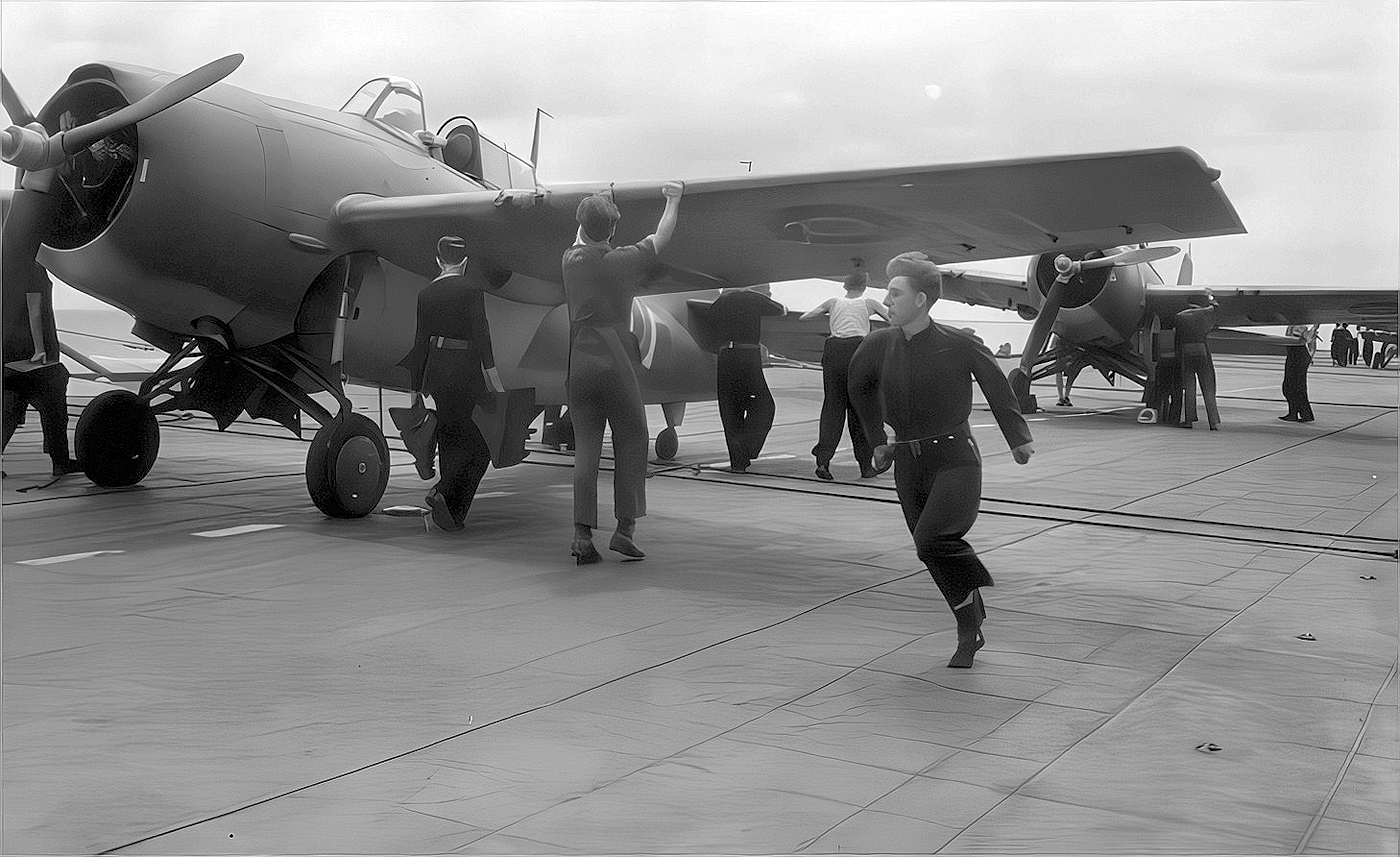
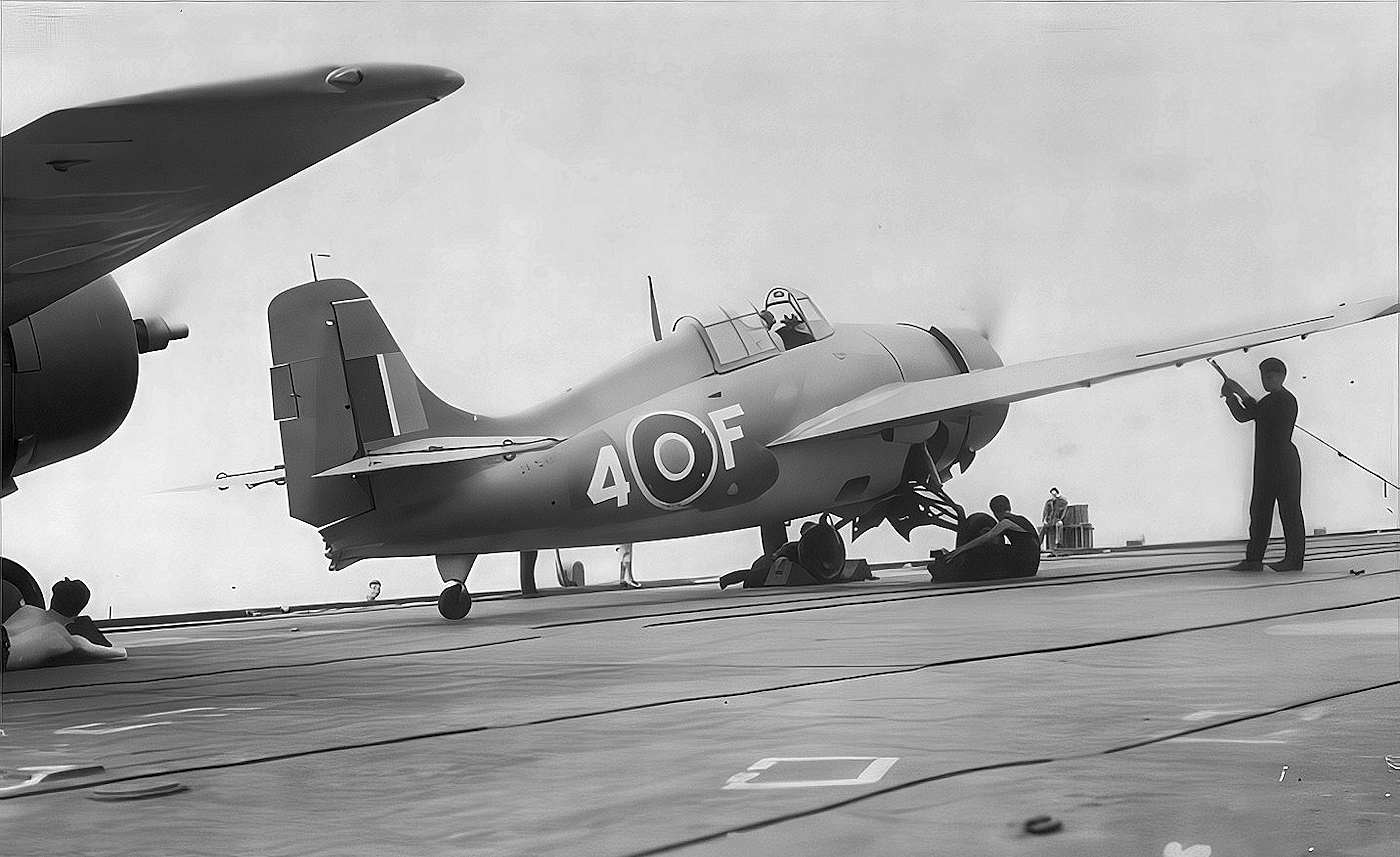
At 16:30 on the 18th, VINDEX launched a Swordfish and two Wildcats to overfly the convoy to allow the DEMS gunners to familiarise themselves with the friendly aircraft. On return to the ship, one of the Wildcats, JV801, piloted by Sub-Lt W. A. Barbour RNVR, drifted to port on landing and fell into the port walkway. The damage kept this machine out of action for the remainder of the operation. For this operation, VINDEX operated as a fighter carrier from 08:00 to 20:00, then switched to A/S carrier operations for the next 12 hours. PREMIER began her first Avenger A/S patrol at 10:00 on the 20th, VINDEX also launched her first Swordfish on taking over at 20:00.
On the 22nd, the first Swordfish launch at 20:00 failed; NS197 ('GQ') suffered RATOG failure on takeoff and ditched off the starboard bow. The crew, Lt Cdr S. G. Cooke RNVR & Lt F. D. Baring-Gould RNVR, were both rescued unhurt by HMCS HAIDA and were returned to the Carrier at 07:00 the next morning.
On the evening of the 23rd, a Swordfish located a U-boat using sonobuoys at 23:15. Both buoys clearly transmitted the sounds of a snorkelling submarine. The weather made night patrols difficult, and no more contacts resulted in any sightings. Wildcats were scrambled at 22:18 on the 24th to intercept a radar contact, which turned out to be a Russian Catalina on an A/S patrol. The convoy met with the Russian escort force at 06:30 on the 25th. The convoy is now split into two sections: 12 ships formed the White Sea (Archangelsk) section, which detached under escort by a local Russian force. Until now, no meaningful enemy force had been encountered; this was about to change. There were 11 U-boats waiting for the convoy, stretched across the entrance to the Kola inlet, and the Swordfish crews now began an intensive patrol period. Around 06:55 on the 25th, VINDEX, PREMIER, BELLONA, ZEALOUS, ZEST and ZEALOUS also detached to proceed to the ' flying off area ' in position 70°10'N, 36°10'E to begin an intensive relay of Swordfish laying sonobuoys at 12-mile intervals along the course of the convoy on approach to Kola inlet. Each aircraft remained overhead, monitoring the buoys for an hour, then returned to the ship once the convoy had passed their line. To help address this U-boat situation, the ships of the 19th Escort Group, made up of the Frigates ANGUILLAL, COTTON, GOODALL, LOCH SHIN, and LOCH INSH, were also sweeping in the approaches to the Kola Inlet to support the convoy. This force had departed Scapa Flow around 20:00 on the 17th and had proceeded directly to the entrance of the Kola Inlet to patrol there in advance of the arrival of the convoy. They had arrived in their patrol area around 15:30 on the 22nd and commenced patrolling. From 07:40, PREMIER launched Avengers in groups of three to conduct A/S sweeps 15 miles ahead of the lead ship in the convoy, and once all vessels had entered the inlet, they switched to patrol seaward. The Destroyer escort left the convoy inside the inlet to rendezvous with the Carrier force to escort them in. VIDEX and PREMIER secured at their berths in Vedanga Bay around midnight.
The ships of the escort force spent the next five days anchored in Vaenga Bay, preparing for the return voyage with convoy RA 66, which was due to sail around 23:00 on the 29th with 24 merchant ships. The return voyage was to see the last convoy battle of the war as a 14-strong U-Boat pack lay in wait for the convoy off the Kola Inlet. A simulated sailing was conducted on the 28th to gauge the German reaction. In order to try to counter the U-boat threat, the 7th Escort Group, CYGNET, ALNWICK CASTLE, BAMBOROUGH CASTLE, FARNHAM CASTLE, HONEYSUCKLE, OXLIP, RHODODENDRON, and LOTUS sailed around 18:15 to sweep ahead of the convoy. They were followed by the 19th Escort Group, which sailed at 19:00 to begin hunting.
At 18:56, LOCH INSH made asdic contact, and two minutes later she attacked with her Squid mortar. U-307 then surfaced and was engaged with gunfire by LOCH INSH, LOCH SHIN, COTTON and CYGNET until it sank at 19:04. Fourteen survivors were picked up by LOCH INSH. At 19:26, GOODALL obtained a good contact, and three minutes later, while adjusting speed to attack with her Hedgehog, she was hit by a torpedo abreast the bridge. LOCH SHIN immediately turned towards her, made contact, and attacked with Squid at 19:43, followed immediately by ANGUILLA, which attacked with depth charges. COTTON then obtained contact and also attacked with depth charges, forcing the U-boat to the bottom. Diesel oil and wreckage were then observed, and another pattern of depth charges was dropped on the oil slick. The submarine, U-286, which was believed to be responsible for attacking GOODALL, was considered destroyed in position 69.29N, 33.37E. Meanwhile, HONEYSUCKLE and FARNHAM CASTLE took off the survivors of GOODALL and landed them at Venenga. Those who were fit to travel then embarked on VINDEX before her departure.
At 20:56, in position 69°32'N, 34°00'E, a torpedo was seen to miss ALNWICK CASTLE, which subsequently obtained a definite submarine contact and carried out two Squid attacks before contact was lost. This was most likely an attack by U-968, which reported attacking an escort vessel with two torpedoes around this time. ALNWICK CASTLE and RHODODENDRON remained patrolling in the area, but contact was not regained. It is not considered that this U-boat was destroyed.
The convoy and its escort destroyers passed Toros Island around midnight during the night of 29/30th April, having been delayed for an hour. Most of the vessels from the 7th and 19th escort groups had joined the screen by 02:30. At 01:48 on the 30th, ZEALOUS and ZODIAC were detached to follow up on a U-boat sighting reported by a Russian aircraft about 6 nautical miles to the north-east of the convoy. ZODIAC sighted the enemy at 02:53, it dived and was immediately attacked. Contact was lost following the attack, but COTTON and LOCH SHIN were ordered to remain in the vicinity until VINDEX, PREMIER, and BELLONA had passed. These did not depart from Venenga Bay until 03:00 and were met by all eight Destroyers off Toros Island, which had doubled back at high speed to screen them around 04:00. VINDEX detected the convoy on radar at approximately 08:00, 35 miles away. VINDEX, PREMIER, and BELLONA joined the convoy around 13:45. As soon as the Carriers and their escorts had cleared the Kola Inlet, A/S patrol aircraft were airborne; PREMIER had a serious crash on deck during the day, Avenger (JZ532 'PE'), suffering from heavy icing, stalled on approach to the rounddown and hit it. A fire broke out, but the flight deck crew quickly brought it under control. The pilot, Sub-Lt A. S. Murray, RNVR, was seriously injured; Sub-Lt N. Muir, RNVR & Leading Airman S. A. Crawford were unhurt, and all managed to walk off the wing onto the flight deck. The aircraft was a write-off and was jettisoned into the sea.
Heavy fog stopped all A/S patrols at 17:00 on May 1st, but at 17:15, radar reported the convoy was being shadowed by at least 2 JU 88s. Wildcats were scrambled from VINDEX on three occasions, but none made successful interceptions. On returning from one of these sorties at 19:33, Wildcat JV802 entered the barrier. PREMIER also had two barrier crashes that day, Avengers JZ521 ('PG') piloted by Lt D. F. Battison RNVR and JZ529 ('PK') piloted by Sub-Lt J. A. Rennie RNVR. Around 20:00, it began to snow heavily, making A/S patrols impossible, but this also hid the convoy from the snooping JU 88s.
The fog lifted around 08:00 on the 2nd, and both A/S and fighter patrols were resumed. Swordfish NF734, piloted by Sub-Lt D. R. Johnston RNVR, broke its arrester hook on a pitching deck and entered the barrier. There were another three Wildcat scrambles during the day, and all the snoopers escaped. Around 17:55 on May 3rd, in position 72°22'N, 01°27'E, BELLONA reported an unidentified aircraft at a range of 18 nautical miles. VINDEX launched two Wildcats at 18:00 to intercept; Lt D. E. Leamon RNVR and Sub-Lt W. V. Machin RNVR spotted a JU 88 and attacked; it was heavily damaged, taking rounds in the cockpit and engine before it was able to escape into the clouds at 1:845. This was the last combat sortie of the passage; no further asdic or radar contacts were detected.
At 13:47 on the 4th, BELLONA, ZEPHYR, ZEALOUS, ZEST, ZODIAC, OFFA, OBEDIENT, and STORD were ordered to proceed to Scapa Flow at best speed. VINDEX and PREMIER parted company with the convoy around 15:00 on the 6th, escorted by IROQUOIS, HAIDA, and HURON, to proceed to Scapa Flow, where they arrived around 23:30. The next morning, Rear Admiral Cunningham Graham, CBE, transferred to DIADEM. On arriving at Scapa, the news that Germany was to surrender was received, and celebrations began. The passage of convoy RA 66 was the last naval engagement of the European War; U-286 was the last U-boat sunk by warships of the Royal Navy. The frigate GOODALL was the last major warship of the Royal Navy lost in the war against Germany.
VINDEX remained at anchor in Scapa Flow until she sailed for the Clyde on May 14th. On her arrival at Greenock the next day, she came under the administration of the Flag Officer, Carrier Training. Leave was granted, and Captain Bayliss went to London for meetings at the Admiralty. On his return, he informed his executive officer, Commander J. D. L. Williams RN DSC, that the ship was to sail for Australia and he was to succeed him in command.
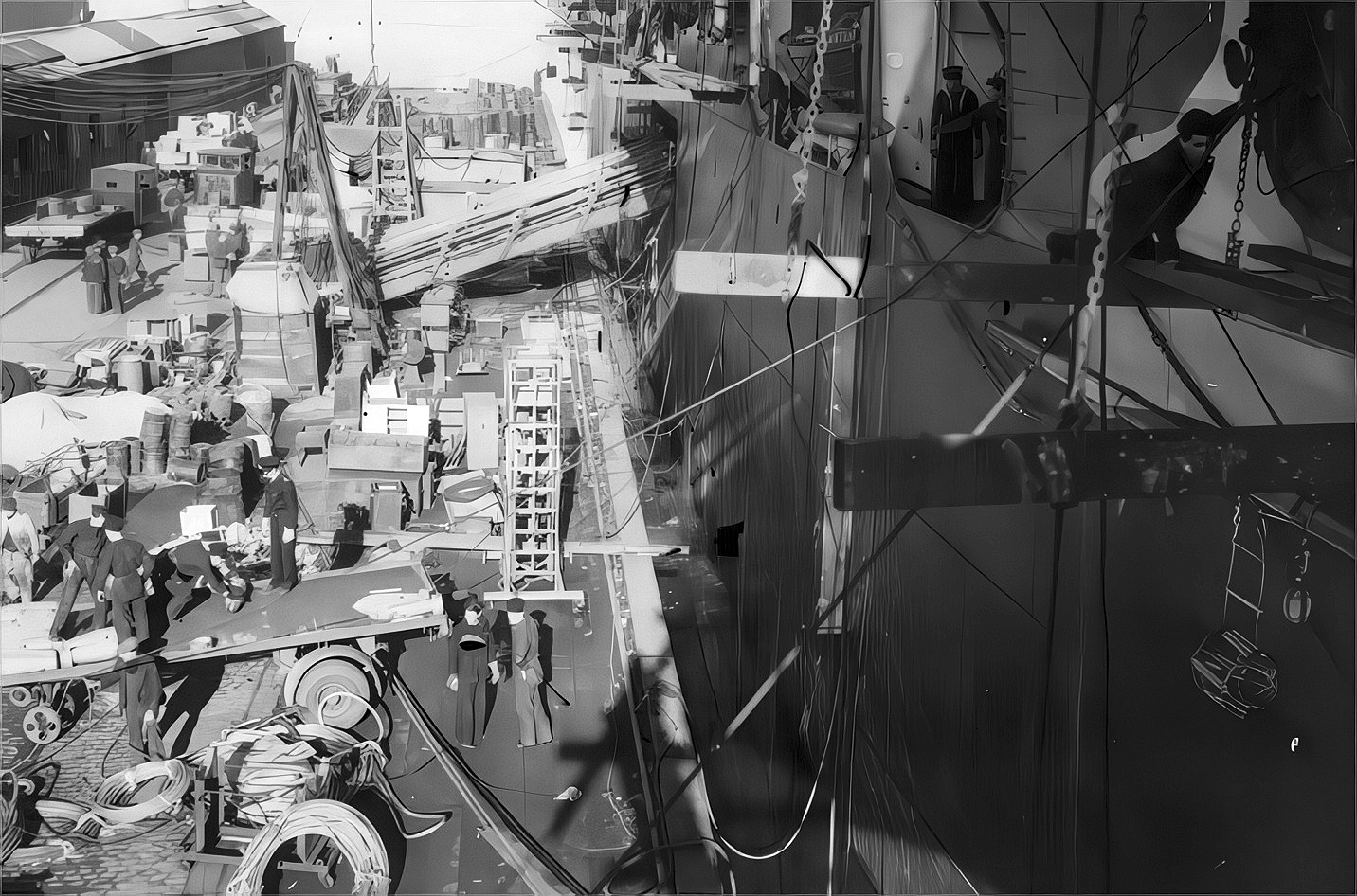
Glasgow, June 1945: VINDEX loading stores and equipment for transport to Australia.
Many of the ship company were drafted off the ship during late May, and her new Captain would be taking a virtually new crew out east. Work started on storing the ship for sailing, and she departed from the Clyde at 13:00 on June 3rd and proceeded to berth alongside at RNAMY Belfast. Here she spent the next three days loading a ferry cargo of Seafires and Barracudas. Her crew complement had been reduced to reflect her new role as a ferry carrier, and the free accommodation this created was soon filled by officers and men forming naval drafts for passage to Colombo and Sydney. For those unlucky enough not to occupy a free billet, large numbers of extra bunk beds had been fitted.
On June 24th, the 12 Firefly INFs of No.1790 squadron arrived at RNAMY Belfast.htm and were hoisted aboard and stored in the hangar. They were followed by the squadron personnel, stores and equipment. Once loading was complete, the ship returned to the Clyde to embark more stores. Captain Bayliss left VINDEX for the final time on Monday, June 28th, to take up his new appointment as Captain of HMS VULTURE, RNAS St.Merryn.
Fully stored and packed with reserve aircraft, VINDEX sailed on July 1st bound for the Suez Canal. She passed Gibraltar on July 5th and arrived at Port Said on the 10th. She entered Colombo harbour on July 21st before proceeding to Trincomalee on the 24th. After unloading a cargo of bombs, she continued her passage to Australia on the 25th, crossing the equator on July 27th. Her course took her east through the Timor Sea and the Torres Strait, passing Cape York in northern Queensland, before turning south for Brisbane, where she anchored on August 11th. The next morning, she went alongside and offloaded her consignment of Barracudas to RNAMY Archerfield.htm. She sailed for Sydney at 16:00. VINDEX was secured at berth 13, Pyrmont, Sydney, on August 13th, and began disembarking passengers and aircraft. All aircraft were craned off and towed through the streets of Sydney to RNAS Bankstown; the Fireflies of 1790 Squadron continued to RNAS Schofields.
Two atomic bombs had been dropped on Japan while VINDEX was on passage, and negotiations for a Japanese surrender had been taking place from August 10th; however, combat operations were still being conducted. Japan officially surrendered on August 15th. With the war over, it was clear that the role of replenishment carrier was no longer necessary. Priority was now given to the reoccupation of occupied territories, the liberation of POWs and rendering humanitarian assistance.

Pyrmont, August 1945: VINDEX loading Red Cross supplies, provisions and equipment for transport to Hong Kong. The ship is now wearing her British Pacific Fleet pennant number ‘R319’.
Round-trip humanitarian voyage to Hong Kong; August 20th - October 3rd
Now emptied of her passengers and cargo, VINDEX was moved to a berth alongside Darling Harbour and was assigned to humanitarian relief duties. A naval draft of 300 men arrived, and Work began almost immediately on loading Red Cross stores, food, clothing and medical supplies for delivery to Hong Kong. She sailed for Brisbane at 11:00 on August 20th. On arrival there on the 22nd, she embarked more stores before sailing for Manus on the 23rd. The ship arrived in Seadler Harbour, Manus, in the Admiralty Islands on August 30th. This was a brief stop to unload some stores and collect mail before sailing for Leyte, in the Philippines. She anchored in Leyte Gulf on September 3rd, sailing again on the 4th.
VINDEX arrived in Hong Kong harbour on September 8th; The harbour had not been fully surveyed for wreckage, so after initially anchoring in the bay, she was moored alongside in a foul berth at Kowloon docks next to the troopship EMPRESS OF AUSTRALIA. During this berthing, the carrier's starboard propeller was damaged by an underwater obstacle.[9]
The ship used its own generators to power the floodlighting in the dock area, allowing unloading to continue through the night. It is highly probable that much of this unloading was done by Japanese POW working parties under the guard of armed sailors. The next day, she relocated to the Naval Dockyard at Victoria, where she unloaded equipment and personnel to begin work on restoring the Dockyard services. Having discharged all of her passengers and stores, VINDEX made ready to receive new passengers for the return journey. On the 14th, 300 Australian prisoners of war began embarking; the hangar deck became a huge mess deck. The clothing loaded onto the ship included replacement uniforms, and each POW received a new uniform and toilet kit to replace the tattered ones they had worn throughout their captivity. These men were deemed fit enough for sea travel, but others with medical conditions brought on by their poor treatment by the Japanese were either sent out by air or to a hospital ship.
On the 17th, sixty-two former internees began embarking; these were British and Australian civilian internees from Stanley prison camp, men, women and children who had been in the colony when it fell to the Japanese in 1942. VINDEX was due to depart from Hong Kong at 14:00 on the 18th, but her sailing was delayed by two hours in order to take on board another group of 126 POWs; these men had been rescued from Ambon Island, some 2,000 miles south in Indonesia, when elements of the Australian Navy arrived on September 10th. Another 56 survivors were embarked on the hospital ship GERUSALEMME, and a further 123 landed at Morotai, were the only survivors out of a force of 1022 Australians originally sent to Ambon to defend the island.
VINDEX sailed from Hong Kong at 16:00 on September 18th, bound for Australia, via the Admiralty Islands. Examination of the damaged propeller showed damage to the tip of one blade; no replacement was available in Hong Kong. A temporary repair was made by welding on a new tip, and the ship achieved 15 knots without excessive vibration.
She arrived in the Admiralty Islands on September 26th and anchored off RNAS Ponam Island, a former US Navy air station loaned to the Admiralty and home to HMS NABARON, Mobile Naval Air Base No. IV, located 5 miles off the north coast of Manus Island. She was here to embark the personnel and equipment of MSR (Maintenance, Storage & Repair) 6, a Fleet Air Arm maintenance unit attached to the station. The island was completely surrounded by a coral reef, so any vessel delivering or collecting supplies or equipment from the base had to lie a long way offshore. Any aircraft or equipment were hoisted onto lighters and ferried through the reef to be unloaded by crane onto the station's single jetty. Loading complete, she sailed for Sydney on September 28th and arrived there on October 3rd. Like RULER before her, the first ship to bring POWs to Australia directly from Japan on September 27th, VINDEX was greeted by almost every house with a view of the water, waving towels and sheets from their windows, and every vessel, large and small, tooting their horns and sirens madly. She secured at 14 Berth, Pyrmont. Here, passengers who needed to be disembarked on stretchers were transported to the RN Auxiliary Hospital in Sydney; the other passengers were transported to HMS GOLDEN HIND , RN Barracks, Sydney, at Warwick Farm. MSR 6 was disembarked at RNAS Bankstown.
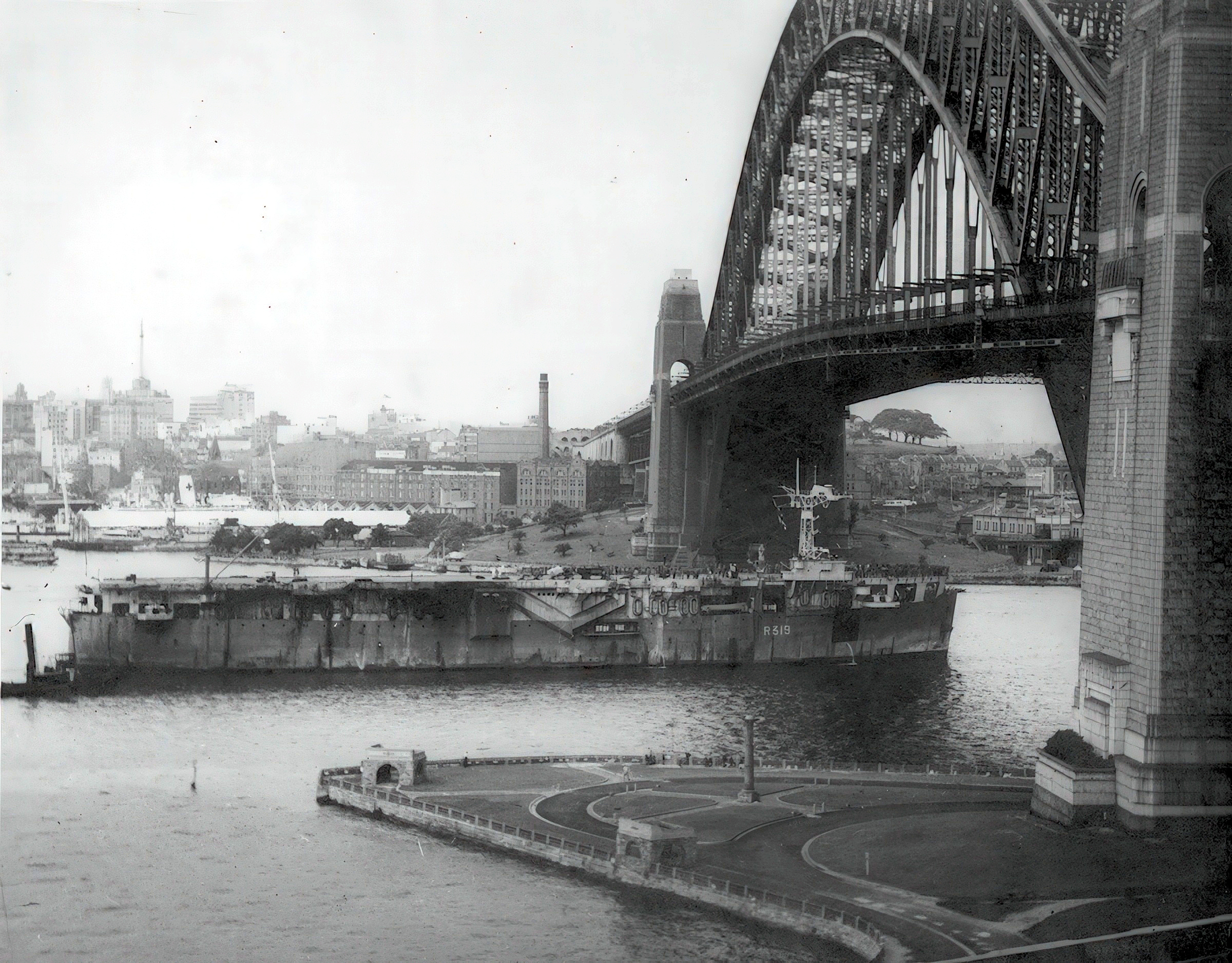
September 26th 1945: VINDEX passing under the Sydney Harbour bridge on her way to berth at Pyrmont, carrying 426 Australian POWs and 62 former internees from Hong Kong.
Once her passengers had all departed, and the equipment and stores of MSR 6 had been offloaded, VINDEX shifted to a berth in Sirius Cove, where dockyard workers came aboard to make improvements to her ventilation system. On completion of this work, parties began loading stores for a second run to Hong Kong. On October 22nd, Commander Williams was temporarily replaced as commanding officer by Captain J. Armstrong, who needed to complete 12 months of service in an RN carrier in preparation for taking command of the RAN's first carrier. He had previously relieved Captain Currey as C.O. of RULER on September 28th, but he was relieved by the ship’s executive officer, Commander Sir M. Culme-Seymour RN, on October 19th when the ship was to sail home to the UK.
Second round trip to Hong Kong, October - December 1945
After loading a second consignment of humanitarian aid supplies and embarking passengers, VINDEX sailed on a second voyage to Hong Kong via Manila around October 23rd. She arrived in Manila around November 4th. This was one of the RAPWI (Recovery of Allied Prisoners of War and Internees) organisation's medical & processing centres; there was another in Singapore. After delivering/exchanging humanitarian supplies, VINDEX sailed from Manila on November 9th. She arrived in Hong Kong on November 14th. In the harbour, VINDEX was in collision with a 20-ton Chinese junk; there was no damage to VINDEX. After unloading and embarking passengers (believed to be more released internees), she sailed from Hong Kong on November 18th and arrived back at Manila on November 23rd. From here, she set course for Papua New Guinea to embark 367 soldiers from the Australian 6th Division at Wewak for transport home. She departed from Wewak on November 29th. [10] On entering Sydney harbour on December 5th, these men lined the flight deck as she berthed at Pyrmont.
Christmas in Hobart, Tasmania
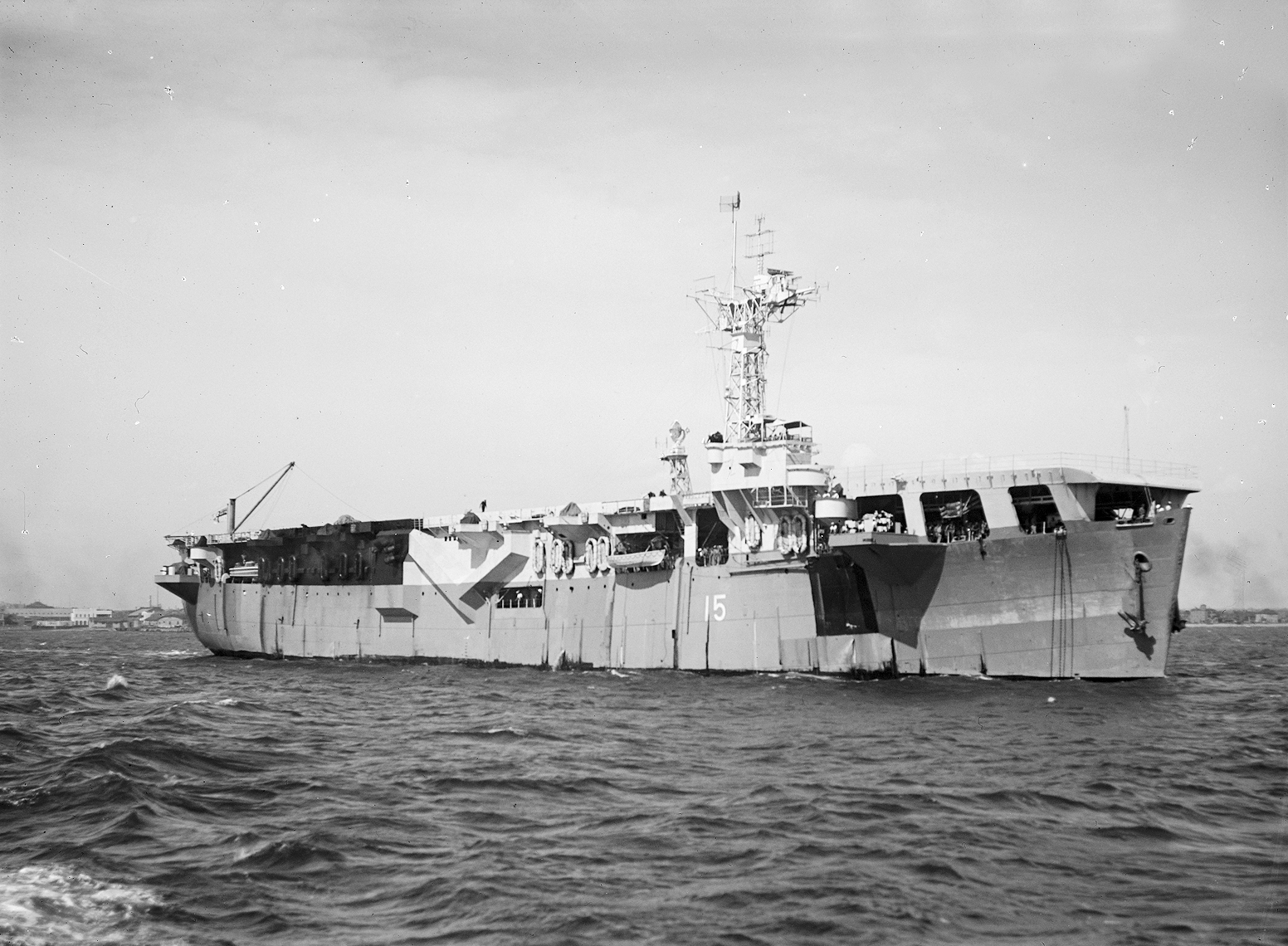
Melbourne, December 22nd 1945: VINDEX at anchor in port Melbourne to collect troops and the the Governor-elect of Tasmania, for passage to Hobart. Note the ship has now reverted to her otiginal pannat number '15'.
After unloading her passengers and cargo, VINDEX stored the ship and embarked a number of Australian servicemen before sailing for Malborne in mid-December. She was in Melbourne by December 17th, and Captain Armstrong was received by Major-General Sir Winston Dugan, Governor of Victoria, at Government House on the 18th. The ship was in the port to embark more Servicemen and women of the three Australian services returning to Tasmania for leave, duty and discharge. In addition, she was here to embark a VIP, the Governor-elect of Tasmania, Admiral Sir Hugh Binney, and Lady Binney. She sailed for Hobart on December 22nd, carrying 512 Australian service personnel. She docked in Hobart on Christmas Eve and was to remain in port for the Christmas holiday. The ship was open to the public between 14:00 and 18:00 on Boxing Day, and it was discovered afterwards that many small items had been taken off the ship as “souvenirs” by visitors. She sailed in the afternoon of the 27th to return to Sydney, carrying 1,000 cases of food for Britain. This was offloaded on arrival back in Sydney for onward shipment.
Third round trip to Hong Kong
At the start of the New Year, it was announced that the Australian Army had cancelled the use of RN Ships for returning troops from the islands. Sailings of the ships, due to leave shortly, were cancelled. It had been decided in December that VINDEX’s proposed employment as either a replenishment or ferry carrier post-war was not feasible; the main reasons were that she lacked a catapult and had only one derrick with a maximum lift of approximately 9,000 pounds. Any aircraft embarked for ferrying would only be possible if both the port of embarkation and the port of delivery had aircraft lighters and cranes available. She was therefore classed as a General Purpose Carrier and was to be employed on local naval trooping, repatriating civilian internees, and delivering cargo to Hong Kong, Singapore and Colombo.
Until now, the U.S.-built CVEs, ARBITER, CHASER, REAPER and STRIKER, had also been making humanitarian voyages from Sydney to Hong Kong, but under the terms of their operation on loan by the Admiralty, they were due to be returned to the U.S. Navy, and had sailed for the UK by the end of January 1946; the exception being SPEAKER, she made two round trips to Hong Kong in December and February but primarily in the ferry role transporting aircraft and Fleet Air Arm units. Six other CVEs: ATHELING, FENCER, PATROLLER, QUEEN, RAJAH, and RANEE had been converted for dedicated trooping duties, and these would now handle the main naval draft lifts between the UK and the Far East. This left VINDEX as the only escort carrier left operating in the humanitarian and general delivery role.
It is believed that VINDEX made a third-round trip to Hong Kong and Singapore in the New Year, arriving back in Sydney on February 10th 1946, to begin a major refit at the Cockatoo Island dockyard, which included a period in dry dock.
&nbsAt the start of March, Captain Armstrong was appointed as the second member of the Australian Commonwealth Naval Board, and command of VINDEX was returned to Commander Willians before she sailed for Hong Kong again on March 24th. Captain Armstrong’s appointment to the first Australian Carrier had been cancelled as a result of a recurring arm injury, which eventually saw him classified as unfit for sea duty, but ideal for the Naval Board, which carried a promotion to Commodore.p;
Change of programme; relocation of the Naval Drafting Pool to Ceylon
It appears that the refit may have been interrupted when the requirement for a large transport vessel arose in March. VINDEX was allocated to relocate the RN Drafting Pool, a part of HMS GOLDEN HIND at Warwick Farm, Sydney, to Colombo, as part of the RN withdrawal from Australia. This new task appears to have resulted in the ship’s planned itinerary being cancelled; she was to have transported a concert party organised by the British Centre in Sydney to Hong Kong, departing on March 24th.
The ‘Pool’ was transhipped as a complete working administrative unit; all the office furniture was embarked in the ship at Garden Island and set up in the hangar as complete working units as though they were ashore, from the Commodore's office downwards. She departed Sydney on March 19th. The idea behind this elaborate hanger setup was to keep the ‘Pool’ working uninterrupted on passage. This could not be achieved for several reasons; initially, some staff could not work due to seasickness, but the ship’s less-than-ideal ventilation system meant that all were half-cooked in the hangar. The hangar was also still a dangerous place to be in rough weather, and the ship reacted in her usual lively way in the swell of the Australian Bight; several Pegasus radial engines still attached to the hangar bulkheads swung out over the heads of the ‘Pool’ staff as the ship rolled. The ship arrived in Colombo around April 1st. The Drafting Pool was offloaded at Colombo to be installed at HMS MAYINA, a former transit camp for the Eastern Fleet just outside the city.
Before sailing to return to Sydney, VINDEX undertook a brief mission to dispose of surplus Lend-Lease airframes. The agreement under which these were supplied specified that, at the end of hostilities, these aircraft were to be either returned or paid for; any lost in combat were written off. However, the US authorities had no need for the surplus aircraft, so authorising their destruction would have written off the debt. VINDEX was only one in a long line of RN carriers that had been tasked with the dumping at sea of perfectly serviceable aircraft, many of which had never flown, and engines. After embarking on such a large disposal load of aircraft, the carrier set out to sea to a secret location, and the crew spent many hours jettisoning the waste overboard. VINDEX arrived back in Sydney on April 11th 1946.
Sailing for the UK
SVINDEX departed from Sydney for the final time on April 26th; her ultimate destination was the UK. The voyage, however, was to be a circuitous one and would take her over four months to complete. The first part of her voyage was to Singapore via Fremantle and Colombo. She called at Fremantle on May 2nd, anchored in Gage Roads at 14:15.
She arrived at Colombo on May 10th, having made 15 knots. Here she was to deliver 300 tons of wheat and collect a naval draft for passage to Durban. The grain had been loaded at Sydney and stored in the forward magazines, which had been cleared of ammunition for the purpose. After exchanging passengers and stores, she sailed for Singapore at 18:00 on the 23rd, arriving on May 28th. Shortly after her arrival in Singapore, she was re-tasked to deliver a shipment of 20 Supermarine Spitfires from Hong Kong to the British Commonwealth Occupation Force in Japan. She sailed from Singapore later that day.
Duty as a Ferry Carrier, June 1946
On arrival at Hong Kong, she disembarked her passengers before embarking RAF personnel and 20 Spitfire XIVE from RAF Kai Tak, Hong Kong; these were brought out to the ship by lighter and hoisted on board by the ship’s crane for transport to Iwakun, Japan. These aircraft, which still wore the squadron code “FF”, were previously operated by No. 132 (City of Bombay) Squadron RAF, which had arrived at Kai Tak in September 1945 on the CVE SMITER, and was disbanded on April 15th, 1946. The aircraft were sent to reinforce the British Commonwealth Occupation Force (BCOF) air component and were intended for Nos. 11 and 17 Squadrons in Japan. On arrival at Iwakun, the aircraft were offloaded using aircraft lighters in late June; the ship, however, remained in the area, anchoring in Hiroshima Bay, where the crew visited the city's ruins, and sailed back to Hong Kong in early July.
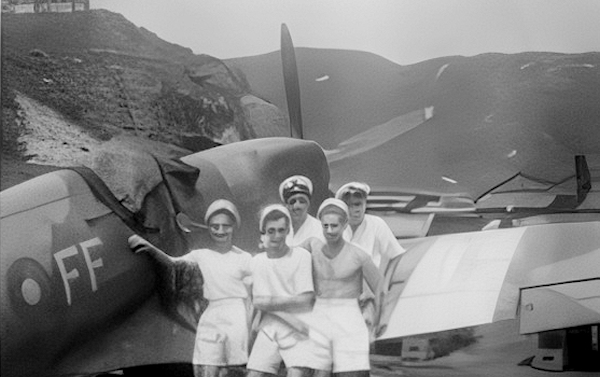
.jpg)
On her return to Hong Kong, she embarked both military and civilian passengers before resuming her voyage to the UK. She left the colony for the last time at 03:09 on July 9th, bound for Singapore, where she arrived on July 15th to embark more passengers. She sailed again at 23:00 the same evening for Colombo. The temporary repair to her starboard propeller had failed at some point on this journey, and the tip again broke off. This caused excessive vibration, and she could only steam on one engine; her speed was reduced to 10.5 knots. The second engine was used only for manoeuvring. A replacement blade was later ordered from Swan Hunter in the UK and would be shipped to the naval dockyard at Simonstown for fitting at a later date. She arrived at Colombo on July 21st. Here she disembarked some of her passengers and cargo before embarking a naval draft, the crew of the river-class frigate HMS SWALE, which was in Simonstown, and due to return to the UK in August following a refit after being on loan to the South African navy.
She called at Mauritius on August 3rd to embark civilians for passage to S. Africa. VINDEX arrived in Durban at 08:00 on August 9th to disembark paddings before sailing for Simonstown on the 11th, arriving there at 07:00 on the 14th. Here she entered dry dock for propeller repair. After engine trials, she embarked a number of boats for delivery to Plymouth. Originally, it was planned that VINDEX would embark 100 Tiger Moth airframes for passage to the UK, but this appears to have been cancelled.
On November 28th, Commander M. R. B. Deane assumed command on her transfer to the reserve. The ship remained at anchor in the Firth into the New Year while her fate was under review. At some point in 1857, she was put up for disposal and taken to Rosyth dockyard to be destroyed and to have the Admiralty equipment removed. VINDEX was sold on October 2nd, 1947, to her original owners, Port Line Ltd, London. She was to be converted into a refrigerated cargo ship in her original builder’s yard, Swan Hunters on the Tyne. The carrier arrived at the builder’s yard the following day under tow from Rosyth by three tugs.
She was allocated yard number 1783 for the rebuilding contract and was renamed MV PORT VINDEX by her owners. The conversion work was completed in May 1949, and she sailed from the Tyne on June 2nd 1946 to begin sailing between Britain, Australia and New Zealand. She was taken out of service in 1971 and was sold for breaking in Kaohsiung, Taiwan. Work began on August 23rd 1971.
Last modified: 26 April 2026
© 1999-2026 The Royal Navy Research Archive All Rights Reserved Powered by W3,CSS
Press F5 to refresh the page after posting your comment or to hide the form
Shape: Standard, circular.
Blazon (Heraldic description) On a white field: A serpent enbowed into a ring, green.
VINDEX: A defender or protector, from the Latin. The badge shows the ouroboros, an ancient symbol for infinity, creation out of destruction.
For explanations of heraldic terms see the
Royal
Navy Ship's Badges page.
Poolman (1983) records this incident as being on the 17th and with Sub-Lt J. E. Moore RNZNVR, a Hurricane pilot, at the controls. Sturtivant & Burrows (1995) have no entry for a bridge collision on the 17th but record it on the 21st.
ClosePoolman (1983) records this as a ditching due to suspected water in the petrol
CloseThis aircraft appears to have been processed through the well-practised repair scheme established in the hangar. At the forward end, a ready-to-use setup, comprising wings, an engine with the prop installed, undercarriage, and a tail assembly slung from the deck head, could resurrect a damaged Swordfish in short order, the ‘new’ mongrel airframe retaining its original serial number. NE868 had suffered damage on the night of the 28th when it drifted into the stbd walkway, but was airborne again for night operations on the 29th.
CloseThis barrier crash is recorded in Poolman (1983) but does not have an entry in Sturtivant & Burrows (1995) Sea Hurricane section.
CloseAn informal, and possibly unit-specific, nickname for Fleet Air Arm pilots who have survived deck landing crashes on aircraft carriers. Similar in nature to the “Goldfish Club”, which is for those who survived ditching, and the Caterpillar Club, for those who successfully used a parachute to bail out of a disabled aircraft. These reflect the dark humour often found in military aviation.
CloseThis crash is recounted in Poolman (1983); however, the aircraft is described as being coded ‘S’, and no serial numbers are given for any of the four aircraft involved. However, Sturtivant & Burrows (1995) record BX126 (Sea Hurricane Ilb) 825 Sqn ('2F')… Out of fuel, belly landed VINDEX 4.944 (S/L JE Moore RNZN). No records for the other damaged aircraft.
CloseSturtivant & Burrows (1995) list two incidents for this crew on November 3rd, an earlier crash being recorded as “NR927 811 Sqn Biter ('F') 21.7.44; Hit rounddown landing at night in rough weather, Cat X Vindex 3.11.44 (S/L JF Bowden & S/L D Evans OK)”; however, Poolman (1983) makes no reference to this incident in his narrative. Given the timing of the fatal crash, it seems highly unlikely that the crew had an earlier sortie; they were returning from a minimum 3-hour patrol and were likely among the first launched after VINDEX took over as the duty CVE that evening.
CloseEvidence to support this is from Sturtivant & Burrows (1995), which records NR923 ('A') Barrier crash 22.11.44 (S/L DG Payne) and NR928 ('M') Low approach at night, stalled, crashed in sea Vindex, Cat Z 24.11.44 (S/L KR Waldron & crew OK). There is no mention of this activity in Poolman (1983).
ClosePoolman (1983) lists this as the port propeller-damaged berthing at Hong Kong next to the EMPRESS OF SCOTLAND; however, Home Command signal traffic refers to the starboard propeller. (Available online at the Naval Historical Branch - from July 1st 1945, War Diary for Home Commands was discontinued. However, important signals in Home Commands were retained, numbered, listed and indexed monthly, and bound.)
CloseThere are anecdotal accounts that on November 26, 1945, the crew of HMS Vindex reportedly held a "sit-down" strike or mutiny while the ship was stationed in Hong Kong. The protest was sparked by ongoing grievances over poor food quality and general conditions on board. The date of this does not match the ship’s timeline and is not mentioned in Poolman (1983).. To be in Wewak, Papua New Guinea, on November 29th, she could not have been in Hong Kong three days earlier. An article “TWO R.N. CARRIERS BRING TROOPS” in The Age (Melbourne, Vic.: 1854 - 1954) Tuesday 4 December 1945 - Page 6 …Vindex, which left Wewak last Thursday, and is due at Sydney tomorrow... suggests that if this "sit-down" strike did happen, on this date the ship would have been at sea approaching Papua New Guinea.
Close
Comments (0)